Ch.8 - Reactions of Alkenes
Wade - Organic Chemistry 9th Edition
Wade9th EditionOrganic ChemistryISBN: 9780135213728Not the one you use?Change textbook
Chapter 8, Problem 33

When 1,2-epoxycyclohexane (cyclohexene oxide) is treated with anhydrous HCl in methanol, the principal product is trans-2-methoxycyclohexanol. Propose a mechanism to account for the formation of this product.

Verified step by step guidance
1
The reaction begins with the protonation of the epoxide oxygen by HCl. This step makes the epoxide more electrophilic and susceptible to nucleophilic attack. The protonated epoxide intermediate is formed.
The protonated epoxide undergoes ring opening. Due to the strain in the three-membered ring, the nucleophile (methanol, CH₃OH) attacks the more substituted carbon of the epoxide. This follows the Markovnikov rule, as the more substituted carbon can better stabilize the partial positive charge in the transition state.
The nucleophilic attack by methanol occurs in an anti fashion (backside attack) relative to the leaving group (protonated oxygen). This anti attack leads to the formation of a trans product.
After the nucleophilic attack, the oxygen from methanol is still protonated. A deprotonation step occurs, where a base (possibly another methanol molecule) removes the extra proton, forming the methoxy group (-OCH₃).
Finally, the hydroxyl group (-OH) and the methoxy group (-OCH₃) are positioned trans to each other on the cyclohexane ring, resulting in the formation of trans-2-methoxycyclohexanol as the principal product.

Verified video answer for a similar problem:

This video solution was recommended by our tutors as helpful for the problem above.
Video duration:
9m
Was this helpful?

Key Concepts

Here are the essential concepts you must grasp in order to answer the question correctly.

Epoxide Reactivity

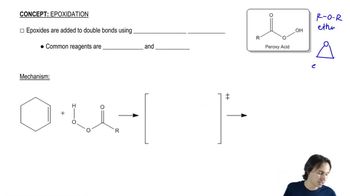
Epoxides are three-membered cyclic ethers that are highly reactive due to the strain in their ring structure. They can undergo nucleophilic attack at the less hindered carbon atom, leading to ring-opening reactions. In the presence of acids, such as HCl, the epoxide oxygen can be protonated, increasing the electrophilicity of the carbon atoms and facilitating nucleophilic substitution.
Recommended video:
Guided course
02:19
General properties of epoxidation.

Nucleophilic Substitution Mechanism

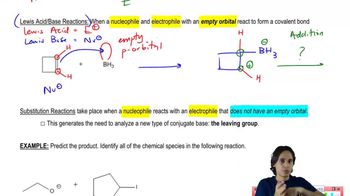
Nucleophilic substitution reactions involve the replacement of a leaving group by a nucleophile. In this case, methanol acts as the nucleophile that attacks the protonated epoxide. The mechanism can proceed via either an SN1 or SN2 pathway, but in this scenario, the sterics and the formation of a stable intermediate suggest an SN2 mechanism, leading to the formation of the desired product.
Recommended video:
Guided course
01:47
Nucleophiles and Electrophiles can react in Substitution Reactions.

Stereochemistry of Product Formation

The stereochemistry of the product is crucial in understanding the outcome of the reaction. The formation of trans-2-methoxycyclohexanol indicates that the nucleophilic attack occurs from the opposite side of the leaving group, resulting in an inversion of configuration at the carbon center. This stereochemical outcome is a key feature of the reaction mechanism and influences the final product's properties.
Recommended video:
1:38
Polymer Stereochemistry Concept 1