Ch. 15 - Reactions of Carboxylic Acids and Carboxylic Acid Derivatives
Bruice - Organic Chemistry 8th Edition
Bruice8th EditionOrganic ChemistryISBN: 9780135213711Not the one you use?Change textbook
Chapter 16, Problem 34a

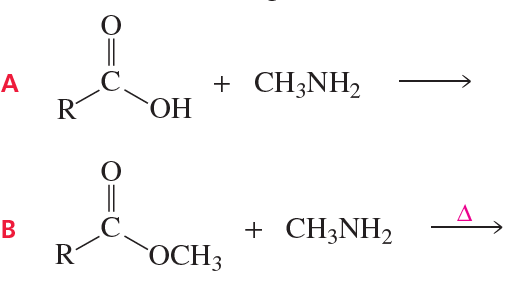
Which of the following reactions lead to the formation of an amide?
Two chemical reaction diagrams showing the formation of an amide from different reactants.

Verified step by step guidance
1
Step 1: Understand the functional groups involved in the reactions. In both reactions, the starting materials include a carboxylic acid derivative (reaction A: carboxylic acid, reaction B: ester) and a nucleophile (methylamine, CH3NH2). Amides are formed when a carboxylic acid derivative reacts with an amine or ammonia.
Step 2: Analyze reaction A. The carboxylic acid (RC=O(OH)) reacts with methylamine (CH3NH2). This reaction typically leads to the formation of an amide, but it requires a dehydrating agent or heat to remove water (H2O) formed during the reaction. Without these conditions, the reaction may not proceed efficiently.
Step 3: Analyze reaction B. The ester (RC=O(OCH3)) reacts with methylamine (CH3NH2) under heat (Δ). This is an example of aminolysis of an ester, where the amine acts as a nucleophile and replaces the alkoxy group (-OCH3) to form an amide. The heat provided facilitates this substitution reaction.
Step 4: Compare the two reactions. Reaction A may lead to the formation of an amide if appropriate conditions (e.g., heat or a dehydrating agent) are applied. Reaction B, under the given conditions (Δ), is more likely to proceed efficiently to form an amide due to the reactivity of esters with amines under heat.
Step 5: Conclude that reaction B is more favorable for the formation of an amide under the given conditions. Reaction A may also form an amide but requires additional conditions to drive the reaction forward.

Verified video answer for a similar problem:

This video solution was recommended by our tutors as helpful for the problem above.
Was this helpful?

Key Concepts

Here are the essential concepts you must grasp in order to answer the question correctly.

Amide Formation

Amides are formed when a carboxylic acid reacts with an amine, resulting in the replacement of the hydroxyl group (-OH) of the acid with an amine group (-NH2). This reaction typically involves the condensation of the two reactants, leading to the release of water. Understanding this process is crucial for identifying which reactions yield amides.
Recommended video:
Guided course
01:33
Amide Nomenclature

Nucleophilic Acyl Substitution

Nucleophilic acyl substitution is a fundamental reaction mechanism in organic chemistry where a nucleophile attacks the electrophilic carbon of a carbonyl group (C=O). In the context of amide formation, the amine acts as the nucleophile, attacking the carbonyl carbon of the carboxylic acid or its derivatives. This mechanism is essential for understanding how amides can be synthesized from various carbonyl-containing compounds.
Recommended video:
Guided course
01:47
Nucleophiles and Electrophiles can react in Substitution Reactions.

Reactivity of Carbonyl Compounds

Different carbonyl compounds exhibit varying reactivities based on their substituents. For instance, carboxylic acids and their derivatives (like acid chlorides and esters) are more reactive than simple aldehydes or ketones. Recognizing the reactivity of these compounds is vital for predicting which reactions will successfully lead to amide formation, as the presence of specific functional groups can significantly influence the outcome.
Recommended video:
Guided course
01:40
Defining meso compounds.