Ch. 15 - Reactions of Carboxylic Acids and Carboxylic Acid Derivatives
Bruice - Organic Chemistry 8th Edition
Bruice8th EditionOrganic ChemistryISBN: 9780135213711Not the one you use?Change textbook
Chapter 16, Problem 3a

Draw the structure for each of the following:
a. phenyl acetate

Verified step by step guidance
1
Understand the name 'phenyl acetate': It is an ester compound where the phenyl group (C₆H₅) is attached to the oxygen atom of the ester, and the acetate group (CH₃COO) forms the rest of the molecule.
Recall the general structure of an ester: Esters have the functional group RCOOR', where R is the alkyl or aryl group attached to the carbonyl carbon, and R' is the group attached to the oxygen atom.
Assign the groups: In phenyl acetate, the R group is CH₃ (from the acetate group), and the R' group is the phenyl group (C₆H₅).
Draw the structure: Start with the ester functional group. Place the carbonyl group (C=O) bonded to a CH₃ group on one side and an oxygen atom on the other. Attach the phenyl group (C₆H₅) to the oxygen atom.
Verify the structure: Ensure that the molecule has the correct connectivity: CH₃-C(=O)-O-C₆H₅. This represents phenyl acetate, with the ester functional group linking the acetate and phenyl groups.

Verified video answer for a similar problem:

This video solution was recommended by our tutors as helpful for the problem above.
Was this helpful?

Key Concepts

Here are the essential concepts you must grasp in order to answer the question correctly.

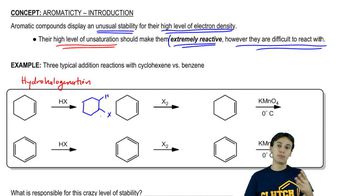
Aromatic Compounds

Aromatic compounds are a class of cyclic compounds that contain conjugated pi electron systems, which follow Hückel's rule (4n + 2 pi electrons). They are characterized by their stability and unique reactivity due to resonance. Phenyl acetate, which contains a phenyl group, is an example of an aromatic compound where the aromatic ring contributes to the overall stability of the molecule.
Recommended video:
Guided course
08:19
Intro to Aromaticity

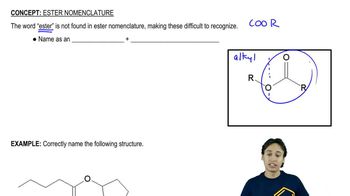
Esters

Esters are organic compounds formed from the reaction of an alcohol and a carboxylic acid, characterized by the functional group -COO-. In phenyl acetate, the acetate group (-OCOCH3) is derived from acetic acid, and the phenyl group (C6H5) is derived from phenol. Esters are known for their distinctive fragrances and are commonly found in natural and synthetic products.
Recommended video:
Guided course
02:39
Ester Nomenclature

Structural Representation

Structural representation in organic chemistry involves depicting the arrangement of atoms within a molecule, including bonds and functional groups. For phenyl acetate, the structure can be drawn to show the phenyl ring attached to the acetate group, highlighting the connectivity and spatial arrangement of atoms. Understanding how to accurately represent molecular structures is crucial for visualizing chemical properties and reactivity.
Recommended video:
Guided course
05:09
Representations of L-Configuration