Ch. 15 - Reactions of Carboxylic Acids and Carboxylic Acid Derivatives
Bruice - Organic Chemistry 8th Edition
Bruice8th EditionOrganic ChemistryISBN: 9780135213711Not the one you use?Change textbook
Chapter 16, Problem 15a

Starting with methyl acetate, what neutral nucleophile would you use to synthesize each of the following compounds? a. ethyl acetate

Verified step by step guidance
1
Identify the starting material and the target compound. The starting material is methyl acetate (CH3COOCH3), and the target compound is ethyl acetate (CH3COOCH2CH3). The goal is to replace the methyl group (-CH3) with an ethyl group (-CH2CH3).
Recognize that this transformation involves a nucleophilic substitution reaction. The methyl group attached to the oxygen atom in methyl acetate can be replaced by an ethyl group using a neutral nucleophile.
Choose a neutral nucleophile that can donate an ethyl group. Ethanol (CH3CH2OH) is a suitable choice because it is a neutral nucleophile and contains the ethyl group needed for the substitution.
Propose the reaction mechanism. The reaction can proceed via transesterification, where ethanol reacts with methyl acetate in the presence of an acid catalyst (e.g., H2SO4) to facilitate the exchange of the alkoxy group.
Write the general reaction: CH3COOCH3 + CH3CH2OH → CH3COOCH2CH3 + CH3OH. The methyl group is replaced by the ethyl group, and methanol (CH3OH) is formed as a byproduct.

Verified video answer for a similar problem:

This video solution was recommended by our tutors as helpful for the problem above.
Video duration:
1m
Was this helpful?

Key Concepts

Here are the essential concepts you must grasp in order to answer the question correctly.

Nucleophiles

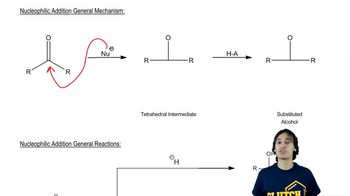
Nucleophiles are species that donate an electron pair to form a chemical bond in a reaction. They are typically negatively charged or neutral molecules with lone pairs of electrons. In organic synthesis, nucleophiles attack electrophilic centers, facilitating various reactions such as nucleophilic substitutions or additions.
Recommended video:
Guided course
08:27
Nucleophilic Addition

Ester Synthesis

Ester synthesis often involves the reaction of an alcohol with a carboxylic acid or its derivatives. In this context, methyl acetate can be transformed into ethyl acetate through nucleophilic substitution, where a neutral nucleophile, such as ethanol, attacks the carbonyl carbon of methyl acetate, displacing the methanol group.
Recommended video:
01:28
Synthesis of Amino Acids: Acetamidomalonic Ester Synthesis Example 2

Reactivity of Acetates

Acetates, like methyl acetate, are relatively reactive due to the presence of the carbonyl group, which is electrophilic. This reactivity allows them to undergo nucleophilic attack by alcohols or other nucleophiles, leading to the formation of new esters. Understanding the reactivity of acetates is crucial for predicting the products of nucleophilic substitution reactions.
Recommended video:
Guided course
04:29
Acetal Protecting Group