
Ch.8 - Reactions of Alkenes
Wade - Organic Chemistry 9th Edition
Wade9th EditionOrganic ChemistryISBN: 9780135213728Not the one you use?Change textbook
Chapter 8, Problem 68

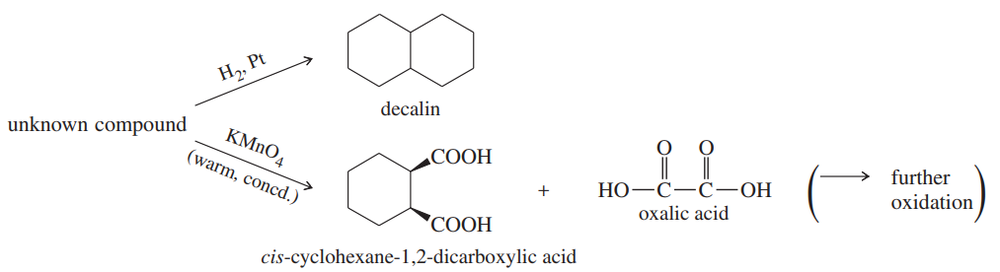
An unknown compound decolorizes bromine in carbon tetrachloride, and it undergoes catalytic reduction to give decalin. When treated with warm, concentrated potassium permanganate, this compound gives cis-cyclohexane-1,2-dicarboxylic acid and oxalic acid. Propose a structure for the unknown compound.
Diagram illustrating the reaction of an unknown compound yielding decalin, cis-cyclohexane-1,2-dicarboxylic acid, and oxalic acid.

Verified step by step guidance
1
Step 1: Analyze the reaction with bromine in carbon tetrachloride. The unknown compound decolorizes bromine, indicating the presence of a double bond or unsaturation in the molecule. This suggests that the compound is an alkene or contains an unsaturated ring system.
Step 2: Examine the catalytic reduction reaction. The unknown compound undergoes catalytic hydrogenation (H₂, Pt) to form decalin, which is a bicyclic saturated hydrocarbon. This implies that the unknown compound is a bicyclic structure with unsaturation that can be reduced to decalin.
Step 3: Consider the oxidation reaction with warm, concentrated potassium permanganate (KMnO₄). The reaction produces cis-cyclohexane-1,2-dicarboxylic acid and oxalic acid. This indicates that the unknown compound contains a double bond in a position that allows cleavage and oxidation to form these products. The cis configuration of the dicarboxylic acid suggests that the double bond is part of a ring system.
Step 4: Propose the structure based on the products. The formation of cis-cyclohexane-1,2-dicarboxylic acid suggests that the double bond is located in a cyclohexane ring, and the production of oxalic acid indicates cleavage of a second double bond outside the ring. This points to a bicyclic structure with one double bond in the cyclohexane ring and another double bond in the second ring.
Step 5: Combine all observations to propose the structure. The unknown compound is likely bicyclo[4.4.1]undeca-1,3-diene, which contains two double bonds: one in the cyclohexane ring and one in the second ring. This structure satisfies the reactions observed and the products formed.

Verified video answer for a similar problem:

This video solution was recommended by our tutors as helpful for the problem above.
Video duration:
6m
Was this helpful?

Key Concepts

Here are the essential concepts you must grasp in order to answer the question correctly.

Electrophilic Addition Reactions

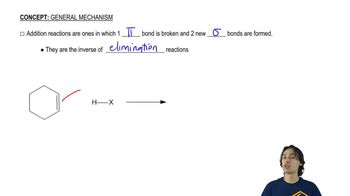
Electrophilic addition reactions involve the addition of electrophiles to nucleophilic sites in alkenes or alkynes. In this case, the unknown compound decolorizes bromine, indicating the presence of a double bond that can react with bromine through electrophilic addition, leading to the formation of a brominated product.
Recommended video:
Guided course
05:39
Features of Addition Mechanisms.

Catalytic Hydrogenation

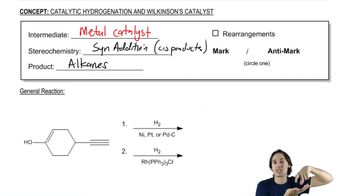
Catalytic hydrogenation is a process where hydrogen gas is added to an unsaturated compound in the presence of a catalyst, typically platinum, palladium, or nickel. The reaction converts alkenes or alkynes into alkanes, as seen in the conversion of the unknown compound to decalin, indicating that the compound likely contains a double bond that is reduced to a single bond.
Recommended video:
Guided course
05:21
General properties of catalytic hydrogenation.

Oxidative Cleavage

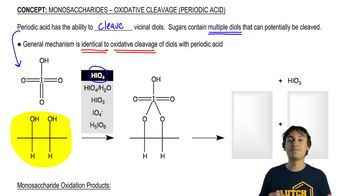
Oxidative cleavage refers to the breaking of carbon-carbon bonds in alkenes or alkynes through oxidation, often using reagents like potassium permanganate (KMnO4). The reaction of the unknown compound with warm, concentrated KMnO4 produces cis-cyclohexane-1,2-dicarboxylic acid and oxalic acid, suggesting that the compound has multiple double bonds that are oxidatively cleaved to form these products.
Recommended video:
Guided course
06:41
Monosaccharides - Oxidative Cleavage