Textbook Question
What is the mistake that was made in drawing each of the flipped chairs on the right from the chair on the left? [In these, assume that the angle through which you view the chair conformations doesn't change.]
(a)
2
views

 Mullins 1st EditionCh. 3 - Alkanes and Cycloalkanes: Properties and Conformational AnalysisProblem 57f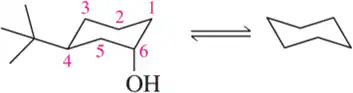
 Verified step by step guidance
 03:29
03:29
 04:02
04:02 05:12
05:12What is the mistake that was made in drawing each of the flipped chairs on the right from the chair on the left? [In these, assume that the angle through which you view the chair conformations doesn't change.]
(a)
For each chair on the left, place the substituents on the flipped chair. [Recall that the axial/equatorial designation changes from one chair to the next, but the carbon to which the substituent is attached does not.]
(c)
Using the numbers shown in the chair conformation on the left, label the carbons of the flipped chair on the right. [Assume that the angle through which you view the chair conformation doesn't change.]
For each pair of conformations shown, choose which is most stable. If both are equally stable, then write 'no difference.' [If both conformations have the same number of axial substituents, choose the one with the smallest axial substituents.]
(e)
For each pair of conformations shown, choose which is most stable. If both are equally stable, then write 'no difference.' [If both conformations have the same number of axial substituents, choose the one with the smallest axial substituents.]
(g)
For each chair on the left, place the substituents on the flipped chair. [Recall that the axial/equatorial designation changes from one chair to the next, but the carbon to which the substituent is attached does not.]
(e)