Ch. 15 - Conjugated Systems, Orbital Symmetry, and Ultraviolet Spectroscopy
Wade - Organic Chemistry 9th Edition
Wade9th EditionOrganic ChemistryISBN: 9780135213728Not the one you use?Change textbook
Chapter 15, Problem 3

The central carbon atom of an allene is a member of two double bonds, and it has an interesting orbital arrangement that holds the two ends of the molecule at right angles to each other.
a. Draw an orbital diagram of allene, showing why the two ends are perpendicular.
b. Draw the two enantiomers of penta-2,3-diene. A model may be helpful.

Verified step by step guidance
1
Step 1: Understand the structure of allene. Allene (propadiene) has a central carbon atom bonded to two other carbon atoms via double bonds. The central carbon is sp-hybridized, meaning it has two perpendicular p orbitals available for π bonding.
Step 2: Draw the orbital diagram for allene. Represent the central carbon atom with two sp orbitals forming sigma bonds with the adjacent carbons. The two perpendicular p orbitals on the central carbon overlap with the p orbitals of the terminal carbons to form π bonds. This arrangement forces the two ends of the molecule to be perpendicular to each other.
Step 3: Analyze the structure of penta-2,3-diene. This molecule contains two double bonds between carbons 2 and 3. The molecule can exist as enantiomers due to the chiral nature of the arrangement of substituents around the double bonds.
Step 4: Draw the enantiomers of penta-2,3-diene. Use wedge and dash notation to represent the spatial arrangement of substituents. One enantiomer will have the substituents arranged in a clockwise manner, while the other will have them arranged counterclockwise.
Step 5: Verify the chirality of the enantiomers. Ensure that the two structures are non-superimposable mirror images of each other, confirming their enantiomeric relationship.

Verified video answer for a similar problem:

This video solution was recommended by our tutors as helpful for the problem above.
Video duration:
4m
Was this helpful?

Key Concepts

Here are the essential concepts you must grasp in order to answer the question correctly.

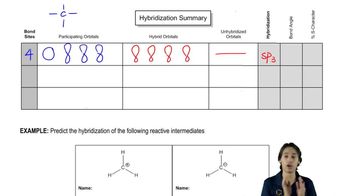
Hybridization

Hybridization is the concept that describes the mixing of atomic orbitals to form new hybrid orbitals, which can explain the geometry of molecular structures. In the case of allene, the central carbon atom undergoes sp² hybridization, allowing it to form two π bonds with adjacent carbon atoms, resulting in a unique arrangement where the terminal groups are perpendicular to each other.
Recommended video:
Guided course
10:43
Using bond sites to predict hybridization

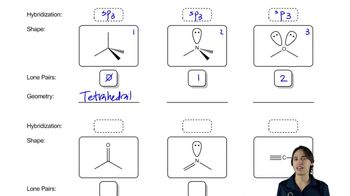
Molecular Geometry

Molecular geometry refers to the three-dimensional arrangement of atoms within a molecule. For allene, the presence of two double bonds leads to a linear arrangement around the central carbon, while the terminal carbons adopt a perpendicular orientation due to the sp² hybridization, creating a distinctive 'cross' shape that is crucial for understanding its reactivity and stereochemistry.
Recommended video:
Guided course
07:44
Molecular Geometry Explained.

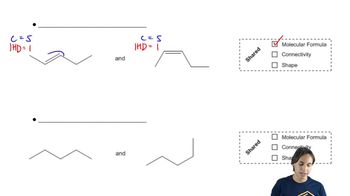
Stereoisomerism

Stereoisomerism is a form of isomerism where molecules have the same molecular formula and connectivity but differ in the spatial arrangement of atoms. In the case of penta-2,3-diene, the presence of double bonds allows for the formation of enantiomers, which are non-superimposable mirror images, highlighting the importance of stereochemistry in organic compounds and their reactions.
Recommended video:
Guided course
01:58
Determining when molecules are stereoisomers.