Ch. 6 - Stereoisomerism: Arrangement of Atoms in Space
Mullins - Organic Chemistry: A Learner Centered Approach 1st Edition
Mullins1st EditionOrganic Chemistry: A Learner Centered ApproachISBN: 9780137566471Not the one you use?Change textbook
Chapter 5, Problem 44

Figure 6.52 <IMAGE> shows the lipase-catalyzed kinetic resolution of secondary alcohols. Show a reaction coordinate diagram that rationalizes the results obtained.

Verified step by step guidance
1
Understand the concept of kinetic resolution: Kinetic resolution is a process where a chiral catalyst (in this case, a lipase enzyme) selectively reacts with one enantiomer of a racemic mixture, leading to the preferential conversion of one enantiomer into a product while leaving the other enantiomer largely unreacted.
Identify the key components of the reaction coordinate diagram: The diagram should include the energy levels of the starting materials (both enantiomers of the secondary alcohol), the transition states for each enantiomer's reaction, and the energy levels of the products.
Recognize the role of the enzyme: The lipase enzyme interacts differently with each enantiomer due to stereochemical differences. This results in different activation energies for the two enantiomers, which will be reflected in the reaction coordinate diagram as two distinct transition states with different energy levels.
Draw the reaction coordinate diagram: Plot the reaction progress on the x-axis and the energy on the y-axis. Start with the racemic mixture of secondary alcohols at the same energy level. Show two separate pathways, one for each enantiomer. The pathway with the lower activation energy corresponds to the enantiomer that reacts more readily with the lipase, while the pathway with the higher activation energy corresponds to the less reactive enantiomer.
Label the diagram: Clearly label the starting materials (R- and S-enantiomers of the secondary alcohol), the transition states (TS_R and TS_S), and the products. Indicate the difference in activation energies (ΔE) between the two pathways to rationalize the selective conversion of one enantiomer over the other.

Verified video answer for a similar problem:

This video solution was recommended by our tutors as helpful for the problem above.
Video duration:
6m
Was this helpful?

Key Concepts

Here are the essential concepts you must grasp in order to answer the question correctly.

Kinetic Resolution

Kinetic resolution is a process used to separate enantiomers of a chiral compound by exploiting differences in their reaction rates. In the context of lipase-catalyzed reactions, one enantiomer reacts faster than the other, allowing for the selective conversion of one form while leaving the other largely intact. This technique is crucial in organic synthesis for obtaining pure enantiomers, which are often required in pharmaceuticals.
Recommended video:
Guided course
08:51
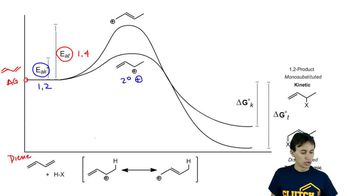
Kinetic vs. Thermodynamic Control

Reaction Coordinate Diagram

A reaction coordinate diagram is a graphical representation that illustrates the energy changes during a chemical reaction as it progresses from reactants to products. It typically shows the energy of the system on the y-axis and the reaction progress on the x-axis. Key features include the activation energy barrier, transition states, and the relative energies of reactants and products, which help visualize the kinetics and thermodynamics of the reaction.
Recommended video:
Guided course
05:02
Coordination Complexes

Enzyme Catalysis

Enzyme catalysis refers to the acceleration of a chemical reaction by a biological catalyst, typically an enzyme. In the case of lipases, these enzymes facilitate the hydrolysis of esters and the resolution of alcohols by providing an active site that stabilizes the transition state, lowering the activation energy required for the reaction. Understanding enzyme specificity and mechanism is essential for predicting the outcomes of reactions involving chiral substrates.
Recommended video:
2:31
Nucleophilic Catalysis Concept 1