Ch. 12 - Infrared Spectroscopy and Mass Spectrometry
Wade - Organic Chemistry 9th Edition
Wade9th EditionOrganic ChemistryISBN: 9780135213728Not the one you use?Change textbook
Chapter 12, Problem 17b

Predict the masses and the structures of the most abundant fragments observed in the mass spectra of the following compounds.
(b) 3-methylhex-2-ene

Verified step by step guidance
1
Identify the molecular structure of 3-methylhex-2-ene. The compound consists of a six-carbon chain with a double bond between carbons 2 and 3, and a methyl group attached to carbon 3.
Understand the fragmentation process in mass spectrometry. The molecule will undergo cleavage at its weakest bonds, often near the double bond or branching points, to form stable carbocations.
Determine the most likely fragmentation sites. For 3-methylhex-2-ene, cleavage can occur at the bond between carbons 2 and 3 (adjacent to the double bond) or at the bond between carbons 3 and 4 (near the branching methyl group).
Predict the masses of the fragments. For example, cleavage at the bond between carbons 2 and 3 will produce a fragment with a mass corresponding to the alkyl group on one side of the cleavage and another fragment with the remaining portion of the molecule. Use the molecular formula of each fragment to calculate its mass.
Draw the structures of the fragments. For each cleavage, represent the resulting carbocations and radicals. Ensure that the most stable carbocations (e.g., tertiary or allylic carbocations) are highlighted, as these are likely to be the most abundant in the mass spectrum.

Verified video answer for a similar problem:

This video solution was recommended by our tutors as helpful for the problem above.
Video duration:
5m
Was this helpful?

Key Concepts

Here are the essential concepts you must grasp in order to answer the question correctly.

Mass Spectrometry

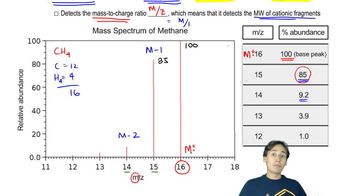
Mass spectrometry is an analytical technique used to measure the mass-to-charge ratio of ions. It helps identify the composition of a sample by generating a mass spectrum, which displays the relative abundance of different ions. Understanding how mass spectrometry works is crucial for predicting the fragments of a compound, as it reveals how molecules break apart under ionization.
Recommended video:
Guided course
01:25
How to Read a Mass Spectrum

Fragmentation Patterns

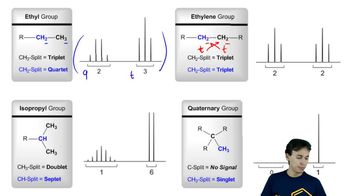
Fragmentation patterns refer to the specific ways in which a molecule breaks apart during mass spectrometry. These patterns are influenced by the structure of the molecule, including the presence of double bonds, branching, and functional groups. Recognizing common fragmentation pathways allows chemists to predict the most abundant fragments and their corresponding masses in the mass spectrum.
Recommended video:
Guided course
08:06
Common Splitting Patterns

Isomerism and Structural Representation

Isomerism is the phenomenon where compounds with the same molecular formula have different structural arrangements. In the case of 3-methylhex-2-ene, understanding its structure is essential for predicting its fragmentation. Structural representation, including the identification of double bonds and branching, aids in visualizing how the molecule can break apart, leading to specific fragments observed in mass spectra.
Recommended video:
Guided course
06:47
Monosaccharides - D and L Isomerism
Related Practice
Textbook Question

Predict the masses and the structures of the most abundant fragments observed in the mass spectra of the following compounds.

(c) 4-methylpentan-2-ol

1
views

Textbook Question

A common lab experiment is the dehydration of cyclohexanol to cyclohexene.

(a) Explain how you could tell from the IR spectrum whether your product was pure cyclohexene, pure cyclohexanol, or a mixture of cyclohexene and cyclohexanol. Give approximate frequencies for distinctive peaks.

(b) Explain why mass spectrometry might not be a good way to distinguish cyclohexene from cyclohexanol.

2
views
Textbook Question

Predict the masses and the structures of the most abundant fragments observed in the mass spectra of the following compounds. (a) 2-methylpentane

2
views
Textbook Question

A C-D (carbon–deuterium) bond is electronically much like a C-H bond, and it has a similar stiffness, measured by the spring constant, k. The deuterium atom has twice the mass (m) of a hydrogen atom, however.

(a) The infrared absorption frequency is approximately proportional to km\(\sqrt{\frac{k}{m}\)} , when one of the bonded atoms is much heavier than the other, and m is the lighter of the two atoms (H or D in this case). Use this relationship to calculate the IR absorption frequency of a typical C-D bond. Use 3000 cm–1 as a typical C-H absorption frequency.

(b) A chemist dissolves a sample in deuterochloroform (CDCl3) and then decides to take the IR spectrum and simply evaporates most of the CDCl3. What functional group will appear to be present in this IR spectrum as a result of the CDCl3 impurity?

1
views
Textbook Question

Convert the following infrared wavelengths to cm-1. (a) 6.24 𝜇m, typical for an aromatic C=C (b) 3.38 𝜇m, typical for a saturated C-H bond (c) 5.85 𝜇m, typical for a ketone carbonyl

2
views
Textbook Question

Four infrared spectra are shown, corresponding to four of the following compounds. For each spectrum, determine the structure and explain how the peaks in the spectrum correspond to the structure you have chosen.

<IMAGE>

1
views