

Ch. 22 - Conjugated Systems II: Pericyclic Reactions
Mullins - Organic Chemistry: A Learner Centered Approach 1st Edition
Mullins1st EditionOrganic Chemistry: A Learner Centered ApproachISBN: 9780137566471Not the one you use?Change textbook
Chapter 21, Problem 56

The Eschenmoser–Claisen reaction is a variant of the Claisen reaction studied in this chapter. Based on your answers to Assessments 22.53–22.55, predict a product of this reaction.
Chemical reaction diagram showing reactants and conditions for the Eschenmoser–Claisen reaction.

Verified step by step guidance
1
Identify the reactants: The first reactant is an allylic alcohol with a phenyl group, and the second reactant is a tertiary amine with two ethoxy groups.
Recognize the reaction type: The Eschenmoser–Claisen reaction involves the formation of a new carbon-carbon bond through a sigmatropic rearrangement, typically involving an allylic alcohol and an amine.
Protonate the amine: The presence of H2SO4 (0.1 equiv.) suggests that the amine will be protonated, making it a better leaving group.
Form the iminium ion: The protonated amine can form an iminium ion, which is a key intermediate in the Eschenmoser–Claisen rearrangement.
Heat-induced rearrangement: Under heat, the allylic alcohol can undergo a [3,3]-sigmatropic rearrangement with the iminium ion, leading to the formation of a new carbon-carbon bond and the rearranged product.

Verified video answer for a similar problem:

This video solution was recommended by our tutors as helpful for the problem above.
Was this helpful?

Key Concepts

Here are the essential concepts you must grasp in order to answer the question correctly.

Eschenmoser–Claisen Reaction

The Eschenmoser–Claisen reaction is a specific type of Claisen condensation that involves the reaction of an enolizable carbonyl compound with an ester in the presence of a base. This reaction typically leads to the formation of β-keto esters or β-dicarbonyl compounds. Understanding the mechanism and conditions of this reaction is crucial for predicting the products formed.
Recommended video:
Guided course
02:10
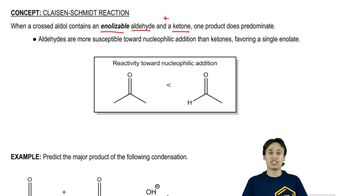
Claisen-Schmidt Reaction

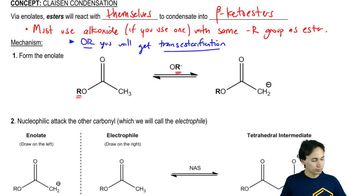
Claisen Condensation

Claisen condensation is a fundamental reaction in organic chemistry where two esters or an ester and a carbonyl compound react in the presence of a strong base to form a β-keto ester or a β-dicarbonyl compound. The reaction involves the nucleophilic attack of an enolate ion on the carbonyl carbon of another ester, followed by the elimination of an alcohol. This concept is essential for grasping the underlying principles of the Eschenmoser–Claisen reaction.
Recommended video:
Guided course
08:28
Claisen Condensation

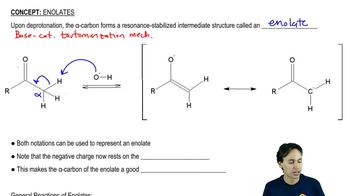
Enolate Ion Formation

Enolate ions are key intermediates in many organic reactions, formed by the deprotonation of an α-hydrogen of a carbonyl compound. In the context of the Eschenmoser–Claisen reaction, the formation of the enolate ion is crucial as it acts as a nucleophile that attacks the carbonyl carbon of another reactant. Understanding how enolate ions are generated and their reactivity is vital for predicting the outcomes of reactions involving carbonyl compounds.
Recommended video:
Guided course
02:26
Formation of Enolates