Ch. 11 - Organometallic Compounds
Bruice - Organic Chemistry 8th Edition
Bruice8th EditionOrganic ChemistryISBN: 9780135213711Not the one you use?Change textbook
Chapter 12, Problem 19a

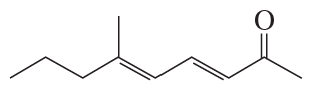
What reactants are needed to synthesize each of the following compounds using a Heck reaction?
a. Chemical structure of a compound involved in the Heck reaction, featuring carbon chains and a carbonyl group.

Verified step by step guidance
1
Step 1: Identify the product structure. The compound shown contains a conjugated system with a double bond adjacent to a ketone group. This suggests that the Heck reaction was used to form the double bond between the alkene and the aromatic or vinyl halide precursor.
Step 2: Recall the Heck reaction mechanism. The Heck reaction involves the coupling of an alkene with an aryl or vinyl halide in the presence of a palladium catalyst and a base. The reaction forms a new C-C bond between the alkene and the halide.
Step 3: Analyze the structure to determine the alkene reactant. The product contains a double bond in the conjugated system, which likely originated from an alkene reactant. The alkene reactant should match the portion of the molecule containing the double bond.
Step 4: Determine the halide reactant. The portion of the molecule containing the ketone group likely originated from a vinyl halide reactant. A vinyl halide with the structure CH3-CH=CH-Br (or similar) would be appropriate.
Step 5: Combine the reactants. The alkene reactant (e.g., 2-methyl-1-butene) and the vinyl halide reactant (e.g., CH3-CH=CH-Br) can be coupled using the Heck reaction conditions: a palladium catalyst (e.g., Pd(OAc)2), a ligand (e.g., triphenylphosphine), and a base (e.g., triethylamine).

Verified video answer for a similar problem:

This video solution was recommended by our tutors as helpful for the problem above.
Video duration:
3m
Was this helpful?

Key Concepts

Here are the essential concepts you must grasp in order to answer the question correctly.

Heck Reaction

The Heck reaction is a palladium-catalyzed coupling reaction between an aryl or vinyl halide and an alkene, resulting in the formation of substituted alkenes. This reaction is significant in organic synthesis for constructing complex molecules and is widely used in the pharmaceutical and materials industries. Understanding the mechanism, which involves oxidative addition, transmetalation, and reductive elimination, is crucial for predicting the products and necessary reactants.
Recommended video:
Guided course
05:09
Heck Reaction

Reactants in Heck Reaction

To successfully perform a Heck reaction, specific reactants are required: an aryl or vinyl halide, an alkene, a palladium catalyst, and a base. The halide provides the aryl or vinyl group, while the alkene serves as the coupling partner. The choice of base can influence the reaction's efficiency and selectivity, making it essential to select appropriate reactants based on the desired product structure.
Recommended video:
Guided course
05:09
Heck Reaction

Product Structure Analysis

Analyzing the structure of the desired product is vital for determining the appropriate reactants for the Heck reaction. The product's functional groups, stereochemistry, and overall connectivity guide the selection of the starting materials. In this case, recognizing the presence of specific substituents and the overall carbon framework in the provided compound helps in identifying the necessary aryl or vinyl halide and alkene to achieve the synthesis.
Recommended video:
Guided course
11:07
Bridged-Products