Ch. 23 - Carbohydrates and Nucleic Acids
Wade - Organic Chemistry 9th Edition
Wade9th EditionOrganic ChemistryISBN: 9780135213728Not the one you use?Change textbook
Chapter 23, Problem 48a,b,c

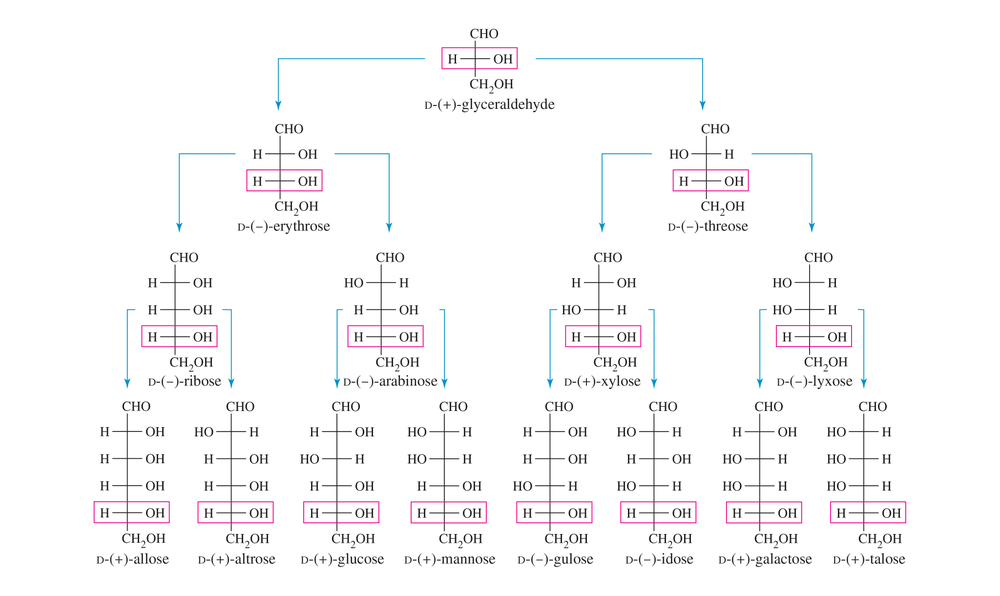
Use Figure 23-3 (the D family of aldoses) to name the following aldoses.
(a) the C2 epimer of D-arabinose
(b) the C3 epimer of D-mannose
(c) the C3 epimer of D-threose
Diagram of aldoses showing D-glyceraldehyde and its enantiomers, including D-galactose and C5 epimer of D-glucose.

Verified step by step guidance
1
Step 1: Understand the concept of epimers. Epimers are stereoisomers that differ in configuration at only one specific carbon atom, while the rest of the molecule remains identical. For aldoses, this means identifying the carbon atom where the configuration changes.
Step 2: For part (a), identify the C2 epimer of D-arabinose. Locate D-arabinose in Figure 23-3 (the D family of aldoses). D-arabinose is a five-carbon aldose (aldopentose). To find its C2 epimer, invert the stereochemistry at the second carbon (C2) while keeping the rest of the molecule unchanged.
Step 3: For part (b), identify the C3 epimer of D-mannose. Locate D-mannose in Figure 23-3. D-mannose is a six-carbon aldose (aldohexose). To find its C3 epimer, invert the stereochemistry at the third carbon (C3) while keeping the rest of the molecule unchanged.
Step 4: For part (c), identify the C3 epimer of D-threose. Locate D-threose in Figure 23-3. D-threose is a four-carbon aldose (aldotetrose). To find its C3 epimer, invert the stereochemistry at the third carbon (C3) while keeping the rest of the molecule unchanged.
Step 5: After identifying the epimers for each part, use the names provided in Figure 23-3 to assign the correct name to each epimer. Ensure that the D-configuration is maintained for all the aldoses.

Verified video answer for a similar problem:

This video solution was recommended by our tutors as helpful for the problem above.
Video duration:
2m
Was this helpful?

Key Concepts

Here are the essential concepts you must grasp in order to answer the question correctly.

Aldoses

Aldoses are a type of monosaccharide characterized by the presence of an aldehyde group (-CHO) at one end of the molecule. They can vary in the number of carbon atoms, and their structure influences their reactivity and biological function. Understanding aldoses is crucial for identifying their epimers, which are stereoisomers differing at one specific carbon atom.
Recommended video:
Guided course
03:21
General Reaction

Epimers

Epimers are a specific type of diastereomer that differ in configuration at only one stereogenic center. In the context of aldoses, identifying epimers involves recognizing how the orientation of hydroxyl (-OH) groups changes at specific carbon atoms. This concept is essential for naming aldoses based on their structural variations, such as the C2 or C3 epimers mentioned in the question.
Recommended video:
Guided course
03:42
Identifying Types of Stereoisomers

D and L Configuration

The D and L configuration refers to the stereochemical designation of sugars based on the orientation of the hydroxyl group on the chiral carbon farthest from the aldehyde group. D-sugars have the hydroxyl group on the right in a Fischer projection, while L-sugars have it on the left. This classification is fundamental for naming aldoses and understanding their relationships, including the identification of epimers.
Recommended video:
Guided course
05:09
Representations of L-Configuration