Ch. 8 - Alkenes I: Properties and Electrophilic Additions
Mullins - Organic Chemistry: A Learner Centered Approach 1st Edition
Mullins1st EditionOrganic Chemistry: A Learner Centered ApproachISBN: 9780137566471Not the one you use?Change textbook
Chapter 7, Problem 45(e)

Which of the following carbocations would you expect to rearrange? If you expect rearrangement, draw the carbocation you expect to form and the mechanism by which it will form.
(e)

Verified step by step guidance
1
Step 1: Analyze the given carbocation structure. The carbocation is attached to a cyclobutane ring, which is a four-membered ring. Cyclobutane rings are strained due to their small size and bond angles deviating from the ideal tetrahedral angle.
Step 2: Determine if the carbocation is likely to rearrange. Carbocations tend to rearrange to form more stable structures. Stability increases with reduced ring strain and higher substitution (tertiary > secondary > primary). Cyclobutane is strained, and rearrangement can relieve this strain.
Step 3: Predict the rearrangement mechanism. A hydride shift or an alkyl shift can occur to move the positive charge to a more stable position. In this case, a ring expansion is likely, where the cyclobutane ring expands to a cyclopentane ring, reducing strain.
Step 4: Draw the expected carbocation after rearrangement. The positive charge will relocate to a position that results in a more stable carbocation, such as a secondary or tertiary carbocation on the expanded cyclopentane ring.
Step 5: Illustrate the mechanism of rearrangement. Show the movement of electrons during the ring expansion, where a bond in the cyclobutane ring breaks and reforms to create the cyclopentane ring, accompanied by the shift of the positive charge.

Verified video answer for a similar problem:

This video solution was recommended by our tutors as helpful for the problem above.
Video duration:
2m
Was this helpful?

Key Concepts

Here are the essential concepts you must grasp in order to answer the question correctly.

Carbocation Stability

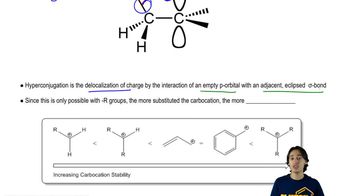
Carbocations are positively charged carbon species that can rearrange to form more stable structures. Stability is influenced by the degree of substitution: tertiary carbocations are more stable than secondary, which are more stable than primary. Understanding the stability of carbocations is crucial for predicting their behavior in reactions, including rearrangements.
Recommended video:
Guided course
05:58
Determining Carbocation Stability

Rearrangement Mechanisms

Carbocation rearrangements typically occur through hydride or alkyl shifts, where a hydrogen atom or alkyl group moves to the positively charged carbon. This process aims to form a more stable carbocation. Recognizing the mechanism of rearrangement is essential for drawing the resulting carbocation and understanding the reaction pathway.
Recommended video:
Guided course
06:08
Definition of Claisen Rearrangement

Reaction Conditions and Context

The likelihood of carbocation rearrangement can depend on the reaction conditions, such as solvent and temperature. Certain conditions may favor rearrangements, while others may stabilize the original carbocation. Analyzing the context of the reaction helps in predicting whether a rearrangement will occur and what the final products will be.
Recommended video:
1:18
EAS Reactions of Pyridine Example 1