Would you expect but-2-ene or 2-methylbut-2-ene to react more quickly with HBr?
Ch. 8 - Alkenes I: Properties and Electrophilic Additions

Mullins1st EditionOrganic Chemistry: A Learner Centered ApproachISBN: 9780137566471Not the one you use?Change textbook
Chapter 7, Problem 34
In your own words, explain why it is not possible to make primary alkyl halides, such as 1-bromopentane, using the electrophilic addition of HCl or HBr to an alkene.

Verified step by step guidance1
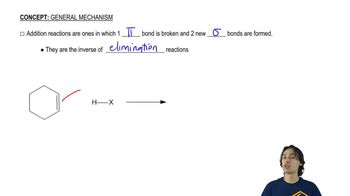
Understand the concept of electrophilic addition: Electrophilic addition is a reaction where an electrophile reacts with an alkene to form a more stable carbocation intermediate, which then reacts with a nucleophile to form the final product.
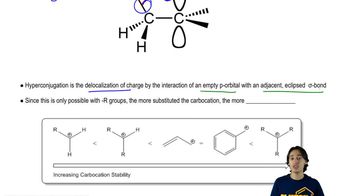
Identify the nature of carbocations: In electrophilic addition, the formation of a carbocation is a key step. Carbocations are more stable when they are tertiary or secondary due to hyperconjugation and inductive effects, rather than primary.
Consider the mechanism of electrophilic addition: When HCl or HBr is added to an alkene, the alkene's π bond attacks the hydrogen, forming a carbocation. The halide ion then attacks the carbocation to form the alkyl halide.
Analyze the stability of carbocations: Primary carbocations are less stable than secondary or tertiary carbocations. Therefore, during electrophilic addition, the reaction tends to favor the formation of more stable carbocations, leading to secondary or tertiary alkyl halides rather than primary.
Conclude why primary alkyl halides are not formed: Due to the instability of primary carbocations, the electrophilic addition of HCl or HBr to an alkene does not favor the formation of primary alkyl halides like 1-bromopentane. Instead, the reaction pathway leads to more stable carbocation intermediates, resulting in secondary or tertiary alkyl halides.

Verified video answer for a similar problem:
This video solution was recommended by our tutors as helpful for the problem above.
Video duration:
5mWas this helpful?
Key Concepts
Here are the essential concepts you must grasp in order to answer the question correctly.
Electrophilic Addition Reaction
Electrophilic addition is a reaction where an electrophile reacts with an alkene, resulting in the addition of atoms across the double bond. The reaction typically involves the formation of a carbocation intermediate, which can lead to rearrangements and the formation of more stable, often secondary or tertiary, carbocations rather than primary ones.
Recommended video:
Guided course
Features of Addition Mechanisms.
Carbocation Stability
Carbocation stability is crucial in electrophilic addition reactions. Secondary and tertiary carbocations are more stable than primary ones due to hyperconjugation and inductive effects. This stability influences the reaction pathway, favoring the formation of more stable carbocations, which leads to secondary or tertiary alkyl halides rather than primary ones.
Recommended video:
Guided course
Determining Carbocation Stability
Markovnikov's Rule
Markovnikov's Rule states that in the addition of HX to an alkene, the hydrogen atom attaches to the carbon with more hydrogen atoms, while the halide attaches to the carbon with fewer hydrogen atoms. This rule predicts the formation of the more stable carbocation, typically resulting in secondary or tertiary alkyl halides, not primary ones like 1-bromopentane.
Recommended video:
Guided course
The 18 and 16 Electron Rule
Related Practice
Textbook Question
1
views
Textbook Question
Provide the expected product for the reaction of each of the following alkenes with (i) HBr and (ii) HBr, H2O2
(b)
2
views
Textbook Question
What is the expected product for the reaction of each of the following alkenes with (i) HBr and (ii) HCl?
(e)
1
views
Textbook Question
Provide an arrow-pushing mechanism that rationalizes the formation of each of the products you predicted in Assessment 8.31. Make sure your mechanism accounts for all products formed, including stereoisomers and regioisomers, where applicable.
1
views
Textbook Question
Provide the expected product for the reaction of each of the following alkenes with (i) HBr and (ii) HBr, H2O2
(c)
1
views
Textbook Question
Provide the expected product for the reaction of each of the following alkenes with (i) HBr and (ii) HBr, H2O2.
(d)
1
views