Ch. 18 - Nucleophilic Acyl Substitution I: Carboxylic Acids
Mullins - Organic Chemistry: A Learner Centered Approach 1st Edition
Mullins1st EditionOrganic Chemistry: A Learner Centered ApproachISBN: 9780137566471Not the one you use?Change textbook
Chapter 17, Problem 68

In Chapter 19, we will learn about the hydrolysis of t-butyl esters. In the reaction below, the hydrolysis is coupled to the decarboxylation reaction learned in this chapter. Suggest a mechanism for this reaction. [Hint: The formation of t-butanol proceeds by an SN1 reaction.]
Chemical reaction diagram showing decarboxylation and hydrolysis, producing a ketone, carbon dioxide, and t-butanol.

Verified step by step guidance
1
The reaction begins with the protonation of the ester carbonyl oxygen by the acid (H2SO4), increasing the electrophilicity of the carbonyl carbon.
Water, acting as a nucleophile, attacks the carbonyl carbon, leading to the formation of a tetrahedral intermediate.
The intermediate undergoes proton transfer to facilitate the departure of the t-butyl group, forming t-butanol. This step proceeds via an SN1 mechanism, where the t-butyl group leaves as a carbocation.
The carbocation is stabilized by the release of CO2, which occurs through decarboxylation. This step is facilitated by the acidic conditions and the formation of a stable cyclic ketone.
Finally, the cyclic ketone is formed as the product, along with the release of CO2 and t-butanol, completing the reaction mechanism.

Verified video answer for a similar problem:

This video solution was recommended by our tutors as helpful for the problem above.
Video duration:
10m
Was this helpful?

Key Concepts

Here are the essential concepts you must grasp in order to answer the question correctly.

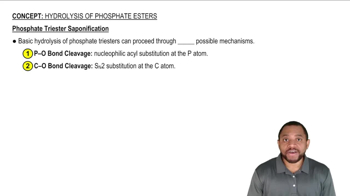
Hydrolysis of Esters

Hydrolysis of esters involves the reaction of an ester with water, leading to the formation of an alcohol and a carboxylic acid. This reaction can be catalyzed by acids or bases and is crucial in organic chemistry for understanding how esters can be converted back to their constituent components. The mechanism typically involves nucleophilic attack by water on the carbonyl carbon of the ester.
Recommended video:
0:48
Hydrolysis of Phosphate Esters Concept 2

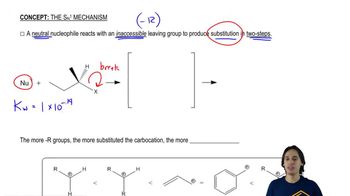
SN1 Reaction Mechanism

The SN1 (Substitution Nucleophilic Unimolecular) mechanism is a two-step process where the rate-determining step involves the formation of a carbocation intermediate after the leaving group departs. This mechanism is characteristic of tertiary substrates, such as t-butyl esters, due to their ability to stabilize the carbocation. The subsequent step involves a nucleophile attacking the carbocation to form the final product.
Recommended video:
Guided course
10:49
Drawing the SN1 Mechanism

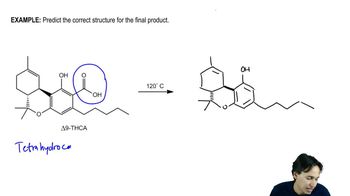
Decarboxylation

Decarboxylation is the process of removing a carboxyl group from a molecule, typically resulting in the release of carbon dioxide. This reaction is significant in organic synthesis and biochemistry, often occurring in the metabolism of fatty acids and amino acids. In the context of the question, decarboxylation may be coupled with hydrolysis to facilitate the formation of t-butanol and other products.
Recommended video:
Guided course
02:32
Predict the correct structure