Show how you would use the Friedel–Crafts acylation, Clemmensen reduction, and/or Gatterman–Koch synthesis to prepare the following compounds: c.
Verified step by step guidance
1
Step 1: Identify the target compound, diphenyl ketone (benzophenone), which has a ketone functional group (C=O) attached to two phenyl groups (Ph). This structure suggests the use of Friedel–Crafts acylation as a key step in the synthesis.
Step 2: Select benzene (C6H6) as the starting material. Friedel–Crafts acylation involves the reaction of an aromatic compound (benzene) with an acyl chloride in the presence of a Lewis acid catalyst, such as AlCl3.
Step 3: Choose benzoyl chloride (C6H5COCl) as the acylating agent. Benzoyl chloride contains the acyl group (C6H5CO-) needed to form the ketone functional group in the target compound.
Step 4: Perform the Friedel–Crafts acylation reaction. Mix benzene with benzoyl chloride in the presence of AlCl3. The Lewis acid catalyst facilitates the generation of the electrophilic acylium ion (C6H5CO+), which reacts with benzene to form benzophenone.
Step 5: After the reaction, isolate and purify the product, diphenyl ketone (benzophenone), using standard organic chemistry techniques such as distillation or recrystallization.
Verified video answer for a similar problem:
This video solution was recommended by our tutors as helpful for the problem above
Video duration:
2m
Play a video:
0 Comments
Key Concepts
Here are the essential concepts you must grasp in order to answer the question correctly.
Friedel–Crafts Acylation
Friedel–Crafts acylation is an electrophilic aromatic substitution reaction that introduces an acyl group into an aromatic ring. This reaction typically uses an acyl chloride and a Lewis acid catalyst, such as aluminum chloride, to form a ketone. It is particularly useful for synthesizing aromatic ketones, such as diphenyl ketone, by acylating a phenyl group with an acyl chloride.
The Clemmensen reduction is a chemical reaction that reduces carbonyl compounds, such as ketones and aldehydes, to alkanes using zinc amalgam and hydrochloric acid. This reaction is particularly useful when the carbonyl compound is sensitive to other reducing agents. In the context of diphenyl ketone, this reduction could be employed to convert the ketone into a hydrocarbon, if desired.
The Gatterman–Koch synthesis is a method for synthesizing aromatic aldehydes from aromatic compounds using carbon monoxide and hydrochloric acid in the presence of a Lewis acid catalyst. This reaction can be used to introduce a formyl group into an aromatic system, which can then be further transformed into ketones or other functional groups. While not directly applicable to diphenyl ketone, understanding this synthesis helps in grasping the broader context of aromatic compound functionalization.

 2:53 minutes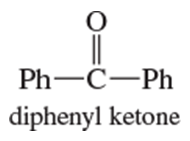
 Verified step by step guidance
 05:20
05:20