Ch. 3 - Alkanes and Cycloalkanes: Properties and Conformational Analysis
Mullins - Organic Chemistry: A Learner Centered Approach 1st Edition
Mullins1st EditionOrganic Chemistry: A Learner Centered ApproachISBN: 9780137566471Not the one you use?Change textbook
Chapter 2, Problem 57c

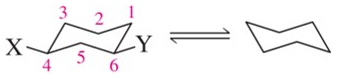
For each chair on the left, place the substituents on the flipped chair. [Recall that the axial/equatorial designation changes from one chair to the next, but the carbon to which the substituent is attached does not.]
(c)

Verified step by step guidance
1
Step 1: Understand the concept of chair flipping in cyclohexane. When a chair conformation flips, the axial substituents become equatorial, and the equatorial substituents become axial. However, the substituents remain attached to the same carbon atoms.
Step 2: Identify the substituents on the original chair conformation. In the given image, substituents X and Y are attached to specific carbons. Note their positions (axial or equatorial) and the carbon numbers they are attached to.
Step 3: Draw the flipped chair conformation. Ensure that the positions of the carbons are correctly flipped, maintaining the overall structure of the cyclohexane ring.
Step 4: Place the substituents X and Y on the flipped chair conformation. For each substituent, switch its designation from axial to equatorial or vice versa, while keeping it attached to the same carbon number as in the original chair.
Step 5: Double-check your work to ensure that the substituents are correctly placed on the flipped chair conformation, with their axial/equatorial designations properly switched and their carbon attachments unchanged.

Verified video answer for a similar problem:

This video solution was recommended by our tutors as helpful for the problem above.
Was this helpful?

Key Concepts

Here are the essential concepts you must grasp in order to answer the question correctly.

Chair Conformation

Chair conformation is a three-dimensional representation of cyclohexane that minimizes steric strain. In this conformation, the carbon atoms are arranged in a way that allows for staggered bonds, making it the most stable form of cyclohexane. Understanding chair conformation is essential for visualizing how substituents are positioned in relation to each other.
Recommended video:
Guided course
03:29
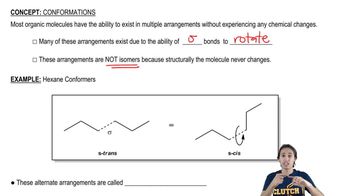
Understanding what a conformer is.

Axial and Equatorial Positions

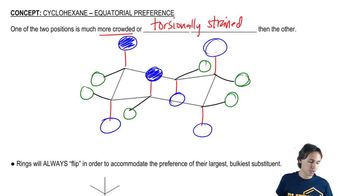
In chair conformations, substituents can occupy two types of positions: axial and equatorial. Axial substituents are oriented perpendicular to the plane of the ring, while equatorial substituents are oriented parallel to the plane. The designation of these positions changes when the chair flips, which is crucial for predicting the stability and interactions of different substituents.
Recommended video:
Guided course
04:02
Equatorial Preference

Chair Flipping

Chair flipping refers to the process of converting one chair conformation of cyclohexane into another. This process involves the rotation of the carbon-carbon bonds, resulting in a new arrangement of axial and equatorial positions. Recognizing how substituents shift between these positions during a chair flip is vital for understanding the dynamics of cyclohexane derivatives.
Recommended video:
Guided course
05:12
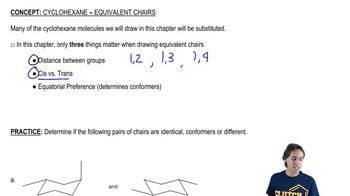
The 3 important factors when drawing chairs
Related Practice
Textbook Question

What is the mistake that was made in drawing each of the flipped chairs on the right from the chair on the left? [In these, assume that the angle through which you view the chair conformations doesn't change.]

(a)

2
views

Textbook Question

Using the numbers shown in the chair conformation on the left, label the carbons of the flipped chair on the right. [Assume that the angle through which you view the chair conformation doesn't change.] 

1
views
Textbook Question

For each chair on the left, place the substituents on the flipped chair. [Recall that the axial/equatorial designation changes from one chair to the next, but the carbon to which the substituent is attached does not.]

(f)

1
views
Textbook Question

For each chair on the left, place the substituents on the flipped chair. [Recall that the axial/equatorial designation changes from one chair to the next, but the carbon to which the substituent is attached does not.]

(e)

1
views
Textbook Question

Looking down the indicated bond, show the three most stable conformations and choose the one that is most stable. Be sure that the first Newman projection you show is the one you see initially (before rotation). [Why should none of your three Newman projections show eclipsed conformations?]

(b) <IMAGE>

2
views
Textbook Question

Looking down the indicated bond, show the three most stable conformations and choose the one that is most stable. Be sure that the first Newman projection you show is the one you see initially (before rotation). [Why should none of your three Newman projections show eclipsed conformations?]

(e) <IMAGE>

5
views