In Chapter 10, you learned how to make an alkyne by acetylide alkylation with a 1° haloalkane. Suggest a mechanism by which this reaction occurs.
Verified step by step guidance
1
Step 1: Begin by identifying the reactants involved in the acetylide alkylation reaction. The key components are the acetylide ion (a strong nucleophile) and the 1° haloalkane (a molecule containing a primary carbon bonded to a halogen). The acetylide ion is typically generated by deprotonating a terminal alkyne using a strong base such as NaNH₂.
Step 2: Recognize the type of reaction mechanism involved. This reaction proceeds via an SN2 (bimolecular nucleophilic substitution) mechanism because the 1° haloalkane is sterically unhindered, allowing the acetylide ion to attack the carbon bonded to the halogen directly.
Step 3: Describe the nucleophilic attack. The acetylide ion, which has a lone pair of electrons on the carbon, attacks the electrophilic carbon of the 1° haloalkane. This carbon is partially positive due to the electronegativity of the halogen atom, which withdraws electron density.
Step 4: Explain the leaving group departure. As the acetylide ion forms a new bond with the electrophilic carbon, the halogen atom (the leaving group) simultaneously departs, taking its bonding electrons with it. This ensures the reaction proceeds in a single concerted step characteristic of the SN2 mechanism.
Step 5: Highlight the product formation. The result of this reaction is a new alkyne with the acetylide group attached to the carbon chain of the original haloalkane. The halogen is released as a halide ion (e.g., Cl⁻, Br⁻, or I⁻), completing the reaction.
Verified video answer for a similar problem:
This video solution was recommended by our tutors as helpful for the problem above
Video duration:
1m
Play a video:
0 Comments
Key Concepts
Here are the essential concepts you must grasp in order to answer the question correctly.
Alkynes and Acetylide Ions
Alkynes are hydrocarbons containing at least one carbon-carbon triple bond. Acetylide ions, which are formed by deprotonating terminal alkynes, are strong nucleophiles that can react with electrophiles, such as haloalkanes. Understanding the structure and reactivity of acetylide ions is crucial for predicting the outcome of the alkylation reaction.
The SN2 mechanism is a type of nucleophilic substitution where the nucleophile attacks the electrophile from the opposite side of the leaving group, resulting in a concerted reaction. This mechanism is characteristic of primary haloalkanes, where steric hindrance is minimal, allowing for effective backside attack by the acetylide ion. Recognizing this mechanism is essential for understanding how the alkylation occurs.
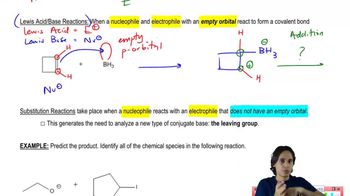
Nucleophiles and Electrophiles can react in Substitution Reactions.
Formation of Alkynes via Alkylation
The process of forming alkynes through acetylide alkylation involves the reaction of an acetylide ion with a primary haloalkane, leading to the formation of a new carbon-carbon bond. This reaction is significant in organic synthesis as it allows for the construction of longer carbon chains and the introduction of functional groups. Familiarity with this transformation is key to grasping the overall synthesis of alkynes.

 1:45 minutes
 Verified step by step guidance
 3:39
3:39