Draw the signal for the following multiplicities. What is the ratio of peaks within each signal? (c) quartet
Verified step by step guidance
1
Understand the concept of multiplicity in NMR spectroscopy: Multiplicity refers to the number of peaks in a signal, which is determined by the number of neighboring hydrogen atoms (n) using the n+1 rule.
Identify the type of multiplicity: A quartet indicates that the signal is split into four peaks. This occurs when there are three neighboring hydrogen atoms (n = 3), as per the n+1 rule (3+1 = 4).
Determine the ratio of peaks: For a quartet, the ratio of the peaks is determined by Pascal's triangle. The ratio for a quartet is 1:3:3:1.
Draw the signal: Visualize the quartet as four peaks on the NMR spectrum, with the middle two peaks being three times as tall as the outer peaks, reflecting the 1:3:3:1 ratio.
Consider the chemical environment: The exact position and spacing of the quartet on the spectrum will depend on the chemical environment and the coupling constant (J value) between the hydrogen atoms.
Verified video answer for a similar problem:
This video solution was recommended by our tutors as helpful for the problem above
Play a video:
0 Comments
Key Concepts
Here are the essential concepts you must grasp in order to answer the question correctly.
NMR Multiplicity
NMR multiplicity refers to the splitting of a signal into multiple peaks due to spin-spin coupling between neighboring hydrogen atoms. The number of peaks in a signal is determined by the number of neighboring hydrogens plus one (n+1 rule). Understanding multiplicity is crucial for interpreting NMR spectra and identifying molecular structures.
A quartet signal in NMR spectroscopy occurs when a hydrogen atom is coupled to three neighboring hydrogens, resulting in four peaks. The quartet follows the n+1 rule, where n is the number of adjacent hydrogens. The peak ratio for a quartet is typically 1:3:3:1, reflecting the probability of different spin states of the neighboring hydrogens.
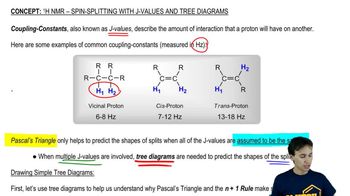
Pascal's Triangle is a mathematical tool used to determine the ratio of peaks in NMR signals. Each row corresponds to the coefficients of the binomial expansion, which represent the relative intensities of the peaks in a multiplet. For a quartet, the third row of Pascal's Triangle (1, 3, 3, 1) provides the peak ratio, aiding in the interpretation of NMR spectra.

 Verified step by step guidance
 10:06
10:06