Ch. 16 - Reactions of Aldehydes and Ketones • More Reactions of Carboxylic Acid Derivatives
Bruice - Organic Chemistry 8th Edition
Bruice8th EditionOrganic ChemistryISBN: 9780135213711Not the one you use?Change textbook
Chapter 17, Problem 86a

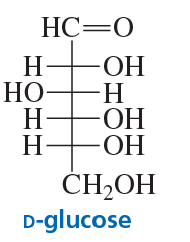
In an aqueous solution, D-glucose exists in equilibrium with two six-membered ring compounds. Draw the structures of these compounds.

Verified step by step guidance
1
Understand that D-glucose is an aldohexose, meaning it contains an aldehyde group and six carbon atoms. In aqueous solution, it undergoes intramolecular cyclization to form cyclic hemiacetals.
Recognize that the cyclization occurs when the hydroxyl group on carbon-5 (C-5) reacts with the aldehyde group on carbon-1 (C-1), forming a six-membered ring structure called a pyranose.
Identify that the cyclization creates a new stereocenter at C-1, known as the anomeric carbon. This results in two possible stereoisomers: the alpha (α) anomer and the beta (β) anomer.
Draw the structure of the α-D-glucopyranose, where the hydroxyl group attached to the anomeric carbon (C-1) is positioned *axially* (down) relative to the ring plane.
Draw the structure of the β-D-glucopyranose, where the hydroxyl group attached to the anomeric carbon (C-1) is positioned *equatorially* (up) relative to the ring plane.

Verified video answer for a similar problem:

This video solution was recommended by our tutors as helpful for the problem above.
Video duration:
7m
Was this helpful?

Key Concepts

Here are the essential concepts you must grasp in order to answer the question correctly.

Anomeric Carbon

The anomeric carbon is the carbon atom in a sugar molecule that is derived from the carbonyl carbon of the open-chain form. In cyclic forms of sugars, it is the carbon that determines the alpha or beta configuration, depending on whether the hydroxyl group is positioned below or above the plane of the ring. Understanding this concept is crucial for drawing the correct structures of d-glucose's cyclic forms.
Recommended video:
Guided course
02:12
Carbonation of Grignard Reagents

Haworth Projection

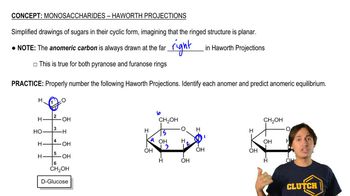
The Haworth projection is a common way to represent the cyclic forms of sugars, showing the ring structure in a two-dimensional format. It illustrates the orientation of substituents around the ring, making it easier to visualize the stereochemistry of the molecule. This representation is essential for accurately drawing the six-membered ring compounds of d-glucose.
Recommended video:
Guided course
04:03
Monosaccharides - Haworth Projections

Mutarotation

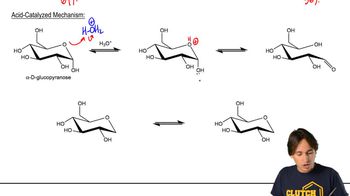
Mutarotation is the process by which the optical rotation of a sugar solution changes over time as the sugar equilibrates between its anomeric forms. For d-glucose, this involves the interconversion between alpha and beta anomers in solution. Understanding mutarotation is important for recognizing the dynamic nature of sugar structures in aqueous environments.
Recommended video: