Ch. 17 - Carbonyl Addition Reactions: Aldehydes and Ketones
Mullins - Organic Chemistry: A Learner Centered Approach 1st Edition
Mullins1st EditionOrganic Chemistry: A Learner Centered ApproachISBN: 9780137566471Not the one you use?Change textbook
Chapter 16, Problem 56d

The following molecules were named incorrectly according to IUPAC nomenclature. Give the correct name of these compounds.
d. (E)-2-methylhex-2-en-6-al

Verified step by step guidance
1
Step 1: Identify the longest carbon chain that contains the highest priority functional group. In this case, the aldehyde group (-CHO) is the highest priority, and the longest chain containing it is a six-carbon chain.
Step 2: Number the carbon chain starting from the end nearest to the highest priority functional group, which is the aldehyde group. This means the aldehyde group should be at position 1.
Step 3: Identify and name any substituents on the main chain. Here, there is a methyl group attached to the second carbon.
Step 4: Determine the correct position and configuration of the double bond. The double bond is between carbon 2 and carbon 3, and it is in the E configuration, meaning the highest priority groups on each carbon are on opposite sides.
Step 5: Combine all the elements to form the correct IUPAC name. The name should reflect the position of the double bond, the configuration, the substituents, and the aldehyde group.

Verified video answer for a similar problem:

This video solution was recommended by our tutors as helpful for the problem above.
Video duration:
4m
Was this helpful?

Key Concepts

Here are the essential concepts you must grasp in order to answer the question correctly.

IUPAC Nomenclature

IUPAC nomenclature is a standardized system for naming chemical compounds. It ensures that each compound has a unique and universally accepted name, based on its structure. Key elements include identifying the longest carbon chain, functional groups, and the position of substituents, ensuring clarity and consistency in chemical communication.
Recommended video:
Guided course
03:43
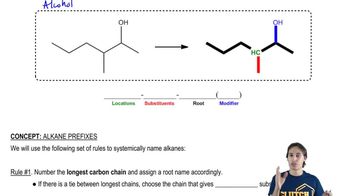
The different parts of an IUPAC name

E/Z Isomerism

E/Z isomerism is a type of stereoisomerism found in alkenes, where the spatial arrangement of substituents around the double bond differs. 'E' (entgegen) indicates that the highest priority groups are on opposite sides, while 'Z' (zusammen) means they are on the same side. This is determined using the Cahn-Ingold-Prelog priority rules, crucial for accurate naming and understanding molecular geometry.
Recommended video:
Guided course
03:48
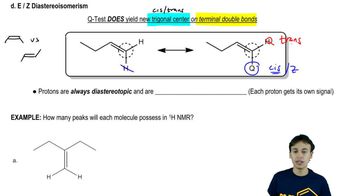
E/Z Diastereoisomerism

Functional Groups in Aldehydes

Aldehydes are organic compounds characterized by the presence of a carbonyl group (C=O) bonded to a hydrogen atom. In nomenclature, the aldehyde group is typically given priority in numbering, and the suffix '-al' is used. Understanding the placement and naming of aldehyde groups is essential for correctly identifying and naming compounds with this functional group.
Recommended video:
Guided course
02:36
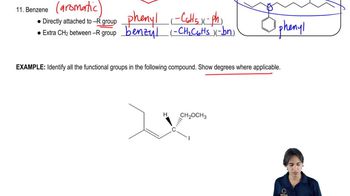
Identifying Functional Groups