Ch. 16 - Reactions of Aldehydes and Ketones • More Reactions of Carboxylic Acid Derivatives
Bruice - Organic Chemistry 8th Edition
Bruice8th EditionOrganic ChemistryISBN: 9780135213711Not the one you use?Change textbook
Chapter 17, Problem 84d

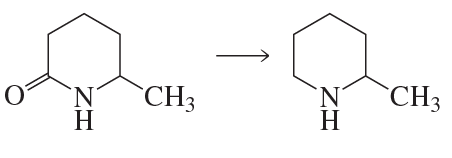
How can the following compounds be prepared from the given starting materials?
d. Chemical reaction showing the reduction of an amine compound, transforming an oxygen-containing structure to a nitrogen structure.

Verified step by step guidance
1
Step 1: Analyze the starting material and the product. The starting material is a cyclic amide (lactam) with a ketone group, and the product is a cyclic amine. This suggests a reduction reaction to convert the amide to an amine.
Step 2: Identify the appropriate reducing agent. Common reducing agents for amides include lithium aluminum hydride (LiAlH4), which is highly effective for reducing amides to amines.
Step 3: Set up the reaction conditions. Dissolve the starting material in a dry solvent such as tetrahydrofuran (THF) and add LiAlH4 slowly under controlled conditions to avoid side reactions.
Step 4: Allow the reaction to proceed. The LiAlH4 will reduce the carbonyl group of the amide to form the corresponding amine. Monitor the reaction progress using techniques like thin-layer chromatography (TLC).
Step 5: Work up the reaction. Quench the reaction by carefully adding water or an acidic solution to destroy excess LiAlH4, then isolate the product by extraction and purification methods such as recrystallization or column chromatography.

Verified video answer for a similar problem:

This video solution was recommended by our tutors as helpful for the problem above.
Video duration:
2m
Was this helpful?

Key Concepts

Here are the essential concepts you must grasp in order to answer the question correctly.

Reduction Reactions

Reduction reactions involve the gain of electrons or the decrease in oxidation state by a molecule. In organic chemistry, this often refers to the conversion of carbonyl groups (C=O) to alcohols (C-OH) or amines (C-NH2). The reaction shown in the image depicts the reduction of an imine or a similar nitrogen-containing compound, which is a common transformation in organic synthesis.
Recommended video:
Guided course
07:12
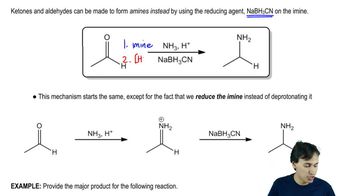
Reductive Amination

Amine Chemistry

Amines are organic compounds derived from ammonia (NH3) by replacing one or more hydrogen atoms with alkyl or aryl groups. They can act as nucleophiles in various reactions, including reductions. Understanding the structure and reactivity of amines is crucial for predicting the outcomes of reactions involving nitrogen-containing compounds, such as the one illustrated in the image.
Recommended video:
Guided course
07:12
Reductive Amination

Mechanism of Reduction

The mechanism of reduction typically involves the transfer of hydride ions (H-) or the addition of hydrogen gas (H2) to the substrate. In the case of the reaction shown, a reducing agent such as lithium aluminum hydride (LiAlH4) or sodium borohydride (NaBH4) may be used to facilitate the conversion of the carbonyl or imine to the corresponding amine. Understanding these mechanisms is essential for predicting reaction pathways and products.
Recommended video:
Guided course
04:40
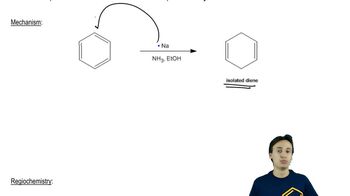
Birch Reduction Mechanism