Ch. 24 - Benzene II: Reactions Influenced by the Aromatic Ring
Mullins - Organic Chemistry: A Learner Centered Approach 1st Edition
Mullins1st EditionOrganic Chemistry: A Learner Centered ApproachISBN: 9780137566471Not the one you use?Change textbook
Chapter 23, Problem 34k

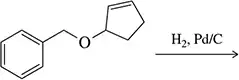
Predict the product(s) of the following reactions.
(k) Chemical structure of an ether with a reaction arrow indicating hydrogenation using H2 and Pd/C catalyst.

Verified step by step guidance
1
Identify the functional groups present in the starting material. The molecule contains an ether linkage (R-O-R') and a cyclopentane ring.
Recognize the reagents used in the reaction. The presence of H2 and Pd/C indicates a catalytic hydrogenation reaction, which typically reduces double bonds or other unsaturated systems.
Consider the stability of the ether linkage under the reaction conditions. Ethers are generally stable to hydrogenation, so the ether bond is unlikely to be cleaved.
Evaluate the potential sites of hydrogenation. Since the molecule does not contain any double or triple bonds, the reaction may not proceed as typical hydrogenation.
Conclude that the reaction conditions may not significantly alter the structure of the starting material, as there are no unsaturated bonds to reduce.

Verified video answer for a similar problem:

This video solution was recommended by our tutors as helpful for the problem above.
Video duration:
4m
Was this helpful?

Key Concepts

Here are the essential concepts you must grasp in order to answer the question correctly.

Hydrogenation

Hydrogenation is a chemical reaction that involves the addition of hydrogen (H2) to a compound, typically in the presence of a catalyst such as palladium on carbon (Pd/C). This process is commonly used to reduce or saturate organic compounds, such as converting alkenes to alkanes. In the context of ethers, hydrogenation generally does not affect the ether linkage unless specific conditions are met.
Recommended video:
Guided course
00:48
The definition of hydrogenation.

Catalysis by Pd/C

Palladium on carbon (Pd/C) is a widely used catalyst in organic chemistry for hydrogenation reactions. It facilitates the addition of hydrogen to unsaturated bonds, such as double or triple bonds, under mild conditions. Pd/C is particularly effective due to its high surface area and ability to adsorb hydrogen, making it a versatile catalyst for various reduction reactions.
Recommended video:
2:31
Nucleophilic Catalysis Concept 1

Stability of Ethers

Ethers are generally stable compounds that resist many types of chemical reactions, including hydrogenation. The ether linkage (C-O-C) is not typically affected by hydrogenation under standard conditions, as it lacks the unsaturated bonds that are usually targeted by such reactions. This stability is due to the strong C-O bond and the lack of reactive sites in the ether structure.
Recommended video:
Guided course
03:43
The radical stability trend.