Ch. 16 - Reactions of Aldehydes and Ketones • More Reactions of Carboxylic Acid Derivatives
Bruice - Organic Chemistry 8th Edition
Bruice8th EditionOrganic ChemistryISBN: 9780135213711Not the one you use?Change textbook
Chapter 17, Problem 34

Excess ammonia must be used when a primary amine is synthesized by reductive amination. What product will be obtained if the reaction is carried out with excess carbonyl compound?

Verified step by step guidance
1
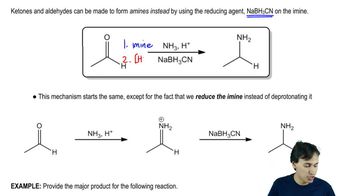
Understand the reaction: Reductive amination involves the reaction of a carbonyl compound (aldehyde or ketone) with ammonia or an amine, followed by reduction to form an amine. The reaction proceeds through the formation of an imine intermediate.
Recognize the role of excess ammonia: When excess ammonia is used, it ensures that the primary amine is the major product by minimizing further reactions. Ammonia reacts with the carbonyl compound to form the imine intermediate, which is then reduced to a primary amine.
Consider the effect of excess carbonyl compound: If the reaction is carried out with excess carbonyl compound, the primary amine formed in the first step can react further with another molecule of the carbonyl compound. This leads to the formation of a secondary imine intermediate.
Understand the reduction of the secondary imine: The secondary imine intermediate can be reduced in the presence of a reducing agent (e.g., NaBH3CN or H2 with a catalyst) to form a secondary amine as the final product.
Conclude the product: When excess carbonyl compound is used, the reaction does not stop at the primary amine stage. Instead, the final product will predominantly be a secondary amine due to the further reaction of the primary amine with the excess carbonyl compound.

Verified video answer for a similar problem:

This video solution was recommended by our tutors as helpful for the problem above.
Was this helpful?

Key Concepts

Here are the essential concepts you must grasp in order to answer the question correctly.

Reductive Amination

Reductive amination is a chemical reaction that involves the conversion of a carbonyl compound (like an aldehyde or ketone) into an amine. This process typically includes the formation of an imine or enamine intermediate, which is then reduced to yield the amine. The presence of excess ammonia ensures that the reaction favors the formation of the primary amine product.
Recommended video:
Guided course
07:12
Reductive Amination

Role of Excess Carbonyl Compound

When excess carbonyl compound is used in reductive amination, it can lead to the formation of secondary or tertiary amines instead of the desired primary amine. This occurs because the excess carbonyl can react with the initially formed primary amine, leading to the formation of imines or enamines that can further react with additional carbonyls, resulting in more complex amine products.
Recommended video:
Guided course
04:21
How to calculate enantiomeric excess.

Amine Classification

Amines are classified based on the number of carbon groups attached to the nitrogen atom: primary (one carbon), secondary (two carbons), and tertiary (three carbons). Understanding this classification is crucial for predicting the outcome of reactions involving amines, as the structure of the amine influences its reactivity and the types of products formed during chemical transformations.
Recommended video:
Guided course
07:12
Reductive Amination