Ch. 15 - Reactions of Carboxylic Acids and Carboxylic Acid Derivatives
Bruice - Organic Chemistry 8th Edition
Bruice8th EditionOrganic ChemistryISBN: 9780135213711Not the one you use?Change textbook
Chapter 16, Problem 87a

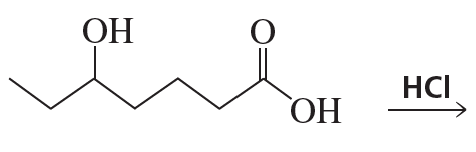
What product do you expect to obtain from each of the following reactions?
a. Chemical structure showing a reaction involving hydroxyl groups and HCl, prompting expected product identification.

Verified step by step guidance
1
Step 1: Analyze the structure of the given compound CH3CH2(COH)CH2CH2CH2(C=O)OH. This molecule contains both an aldehyde group (-CHO) and a carboxylic acid group (-COOH). Identify the functional groups and their reactivity in the presence of HCl.
Step 2: Recognize that HCl is a strong acid and can protonate functional groups. In this case, the carboxylic acid group (-COOH) is already acidic, so it will not undergo significant change. However, the aldehyde group (-CHO) may undergo acid-catalyzed reactions such as hydration or polymerization.
Step 3: Consider the possibility of acid-catalyzed hydration of the aldehyde group. In the presence of HCl, the aldehyde group (-CHO) can react with water to form a geminal diol (a molecule with two hydroxyl groups attached to the same carbon). This reaction is reversible and depends on the reaction conditions.
Step 4: Evaluate the stability of the molecule after the reaction. The carboxylic acid group (-COOH) remains unchanged, while the aldehyde group may convert to a geminal diol. Write the expected product structure based on this transformation.
Step 5: For part b, clarify that no specific reactant is provided other than HCl. If the reactant is missing, the reaction cannot be analyzed. Ensure the student provides the complete reactant structure to proceed with the solution.

Verified video answer for a similar problem:

This video solution was recommended by our tutors as helpful for the problem above.
Video duration:
11m
Was this helpful?

Key Concepts

Here are the essential concepts you must grasp in order to answer the question correctly.

Functional Groups

Functional groups are specific groups of atoms within molecules that are responsible for the characteristic chemical reactions of those molecules. In the given question, the presence of hydroxyl (-OH) and carbonyl (C=O) groups indicates that the compounds are alcohols and carboxylic acids, respectively. Understanding these functional groups is essential for predicting the products of the reactions.
Recommended video:
Guided course
02:36
Identifying Functional Groups

Acid-Base Reactions

Acid-base reactions involve the transfer of protons (H+) between reactants. In the context of the reactions provided, HCl acts as a strong acid that can protonate functional groups, influencing the reactivity of the organic compounds. Recognizing how acids interact with alcohols and carboxylic acids is crucial for determining the expected products.
Recommended video:
Guided course
02:49
The Lewis definition of acids and bases.

Reaction Mechanisms

Reaction mechanisms describe the step-by-step process by which reactants transform into products. Understanding the mechanisms involved in the reactions with HCl, such as protonation and subsequent nucleophilic attack, is vital for predicting the final products. This knowledge helps in visualizing how the structure of the reactants changes during the reaction.
Recommended video:
Guided course
02:16
Heck Reaction Mechanism