
Textbook Question
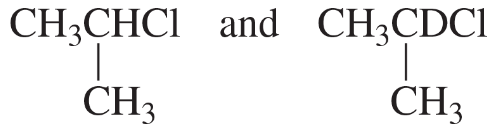
Label each set of chemically equivalent protons, using a for the set that will be at the lowest frequency in the 1H NMR spectrum, b for the next lowest, and so on. Indicate the multiplicity of each signal.
c.

 Verified step by step guidance
 06:46
06:46
 11:44 06:46
Label each set of chemically equivalent protons, using a for the set that will be at the lowest frequency in the 1H NMR spectrum, b for the next lowest, and so on. Indicate the multiplicity of each signal.
c.
Determine the ratios of the chemically nonequivalent protons in a compound if the steps of the integration curves measure 40.5, 27, 13, and 118 mm, from left to right across the spectrum. Draw the structure of a compound whose 1H NMR spectrum would show these integrals in the observed order.
Answer the following questions:
c. What is the relationship between coupling constant in hertz and operating frequency?
d. How does the operating frequency in NMR spectroscopy compare with the operating frequency in IR and UV/Vis spectroscopy?
The 1H NMR spectra of three isomers with molecular formula C4H9Br are shown here. Which isomer produces which spectrum?
a. <IMAGE>
Match each of the 1H NMR spectra with one of the following compounds:
b. <IMAGE>
Label each set of chemically equivalent protons, using a for the set that will be at the lowest frequency in the 1H NMR spectrum, b for the next lowest, and so on. Indicate the multiplicity of each signal.
a.