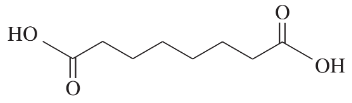
Using cyclooctyne as your starting material, show how you would synthesize the following compounds. (Once you have shown how to synthesize a compound, you may use it as the starting material in any later parts of this problem.) (i)
Verified step by step guidance
1
Step 1: Begin with cyclooctyne as the starting material. Cyclooctyne is an eight-membered ring containing a triple bond. The triple bond is highly reactive and can undergo addition reactions to introduce functional groups.
Step 2: Perform an oxidative cleavage of the alkyne bond in cyclooctyne using a reagent such as ozone (O₃) followed by reductive workup (e.g., Zn and acetic acid). This will break the triple bond and yield two molecules of carboxylic acids.
Step 3: Extend the carbon chain by performing a series of reactions to introduce additional carbons. For example, use a Grignard reaction or alkylation to add carbon chains to the carboxylic acid groups formed in the previous step.
Step 4: Introduce the hydroxyl group (-OH) on the terminal carbon by using a selective oxidation reaction. For example, use a reagent like PCC (Pyridinium chlorochromate) or Jones reagent to oxidize the alcohol to a ketone or aldehyde, followed by further functionalization.
Step 5: Adjust the positions of the functional groups (hydroxyl and carboxylic acid) through selective reactions such as esterification, hydrolysis, or rearrangement to achieve the final target compound structure as shown in the image.
Verified video answer for a similar problem:
This video solution was recommended by our tutors as helpful for the problem above
Video duration:
3m
Play a video:
0 Comments
Key Concepts
Here are the essential concepts you must grasp in order to answer the question correctly.
Cyclooctyne Structure and Reactivity
Cyclooctyne is a cyclic alkyne with a unique structure that influences its reactivity. Its strained ring system allows for various reactions, including cycloadditions and functional group transformations. Understanding its geometry and electronic properties is crucial for predicting how it can be transformed into other compounds.
Synthesis in organic chemistry involves planning a series of chemical reactions to construct a desired compound from simpler starting materials. Key strategies include functional group interconversions, rearrangements, and the use of protecting groups. Familiarity with these strategies is essential for designing a synthetic pathway from cyclooctyne to the target compounds.
Understanding reaction mechanisms is vital for predicting the outcomes of chemical reactions. Mechanisms describe the step-by-step process of how reactants transform into products, including the formation and breaking of bonds. Knowledge of common mechanisms, such as nucleophilic substitutions and electrophilic additions, will aid in determining how to effectively synthesize the desired compounds from cyclooctyne.