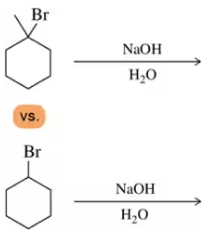
For which of the following reactions would you expect elimination to be more favored than substitution? (b)
Verified step by step guidance
1
Step 1: Analyze the structure of the alkyl halides in both reactions. The first structure contains a tertiary alkyl bromide, while the second structure contains a secondary alkyl bromide. Tertiary alkyl halides are more prone to elimination reactions due to steric hindrance, which makes substitution less favorable.
Step 2: Consider the reaction conditions. The presence of NaOH in H2O suggests a basic environment. In such conditions, elimination reactions (E2 mechanism) are often favored, especially for tertiary alkyl halides, as the base can abstract a proton from a β-carbon to form an alkene.
Step 3: Evaluate the competition between substitution and elimination. For the tertiary alkyl bromide, steric hindrance around the carbon bearing the leaving group (Br) makes nucleophilic attack difficult, favoring elimination. For the secondary alkyl bromide, substitution (SN2 mechanism) is more competitive due to less steric hindrance.
Step 4: Consider the role of the solvent (H2O). Water is a polar protic solvent, which can stabilize the transition state for elimination reactions. This further supports elimination being favored for the tertiary alkyl bromide.
Step 5: Conclude that elimination is more favored for the reaction involving the tertiary alkyl bromide compared to the secondary alkyl bromide, due to steric hindrance and the basic reaction conditions promoting the E2 mechanism.
Verified video answer for a similar problem:
This video solution was recommended by our tutors as helpful for the problem above
Video duration:
3m
Play a video:
0 Comments
Key Concepts
Here are the essential concepts you must grasp in order to answer the question correctly.
Elimination vs. Substitution Reactions
In organic chemistry, elimination reactions involve the removal of atoms or groups from a molecule, resulting in the formation of a double bond, while substitution reactions involve replacing one atom or group with another. The preference for one type of reaction over the other can depend on factors such as the structure of the substrate, the nature of the nucleophile or base, and the reaction conditions.
Zaitsev's Rule states that in elimination reactions, the more substituted alkene is generally the favored product. This is because more substituted alkenes are typically more stable due to hyperconjugation and the inductive effect. Understanding this rule helps predict the outcome of elimination reactions, especially when comparing different substrates.
Steric hindrance refers to the crowding around a reactive center in a molecule, which can influence the pathway of a reaction. In the context of elimination versus substitution, bulky bases favor elimination due to their inability to approach the substrate for substitution. Additionally, the strength and size of the nucleophile or base can significantly affect whether substitution or elimination is favored in a given reaction.