At 600 °C, the ratio of the relative rates of formation of a tertiary, a secondary, and a primary radical by a chlorine radical is 2.6 : 2.1 : 1. Explain the change in the degree of regioselectivity compared to what was found in Problem 44.
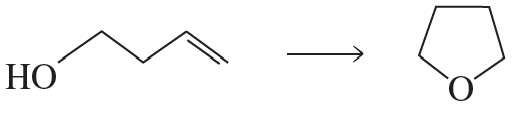
Using the given starting material and any necessary organic or inorganic reagents, indicate how the desired compounds could be synthesized:
a. 
Verified step by step guidance
Verified video answer for a similar problem:
Key Concepts
Radical Reactions
Cyclic Ether Formation
Reagents and Conditions
Starting with cyclohexane, how could the following compounds be prepared?
e.
Given that ∆H° for the reaction is -42 kcal/mol and the bond dissociation enthalpies for the C−H, C−Cl, and O−H bonds are 101, 85, and 105 kcal/mol respectively, calculate the bond dissociation enthalpy of the O−Cl bond.
Using the given starting material and any necessary organic or inorganic reagents, indicate how the desired compounds could be synthesized:
c.
A chemist wanted to determine experimentally the relative ease of removing a hydrogen atom from a tertiary, a secondary, and a primary carbon by a chlorine radical. He allowed 2-methylbutane to undergo chlorination at 300 °C and obtained as products 36% 1-chloro-2-methylbutane, 18% 2-chloro-2-methylbutane, 28% 2-chloro-3-methylbutane, and 18% 1-chloro-3-methylbutane. What values did he obtain for the relative ease of removing a hydrogen atom from tertiary, secondary, and primary hydrogen carbons by a chlorine radical under the conditions of his experiment?

Propose a mechanism for the following reaction: