Ch. 6 - Stereoisomerism: Arrangement of Atoms in Space
Mullins - Organic Chemistry: A Learner Centered Approach 1st Edition
Mullins1st EditionOrganic Chemistry: A Learner Centered ApproachISBN: 9780137566471Not the one you use?Change textbook
Chapter 5, Problem 45b

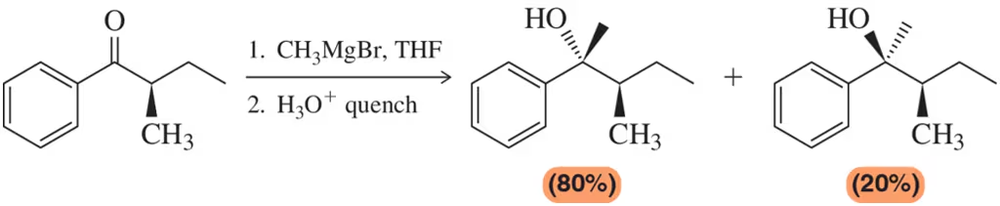
We discuss the reaction of Grignard reagents (organomagnesium compounds) to ketones in Chapter 17. Mechanistically, the reaction proceeds by the nucleophilic addition of a methyl carbanion to the electrophilic carbon of the carbonyl, breaking the C―Oπ bond, resulting in an alkoxide intermediate that is subsequently protonated to produce the 3° alcohol.
(b) Why, when the substrate is modified slightly, does the reaction result in an excess of one stereoisomer?
Grignard reaction with ketone forms two alcohol stereoisomers, major (80%) and minor (20%) products shown.

Verified step by step guidance
1
Step 1: Understand the basic mechanism of the Grignard reaction. Grignard reagents are organomagnesium compounds that act as nucleophiles. They attack electrophilic carbon atoms, such as those in carbonyl groups, leading to the formation of new carbon-carbon bonds.
Step 2: Recognize the role of stereochemistry in reactions involving chiral centers. When a Grignard reagent reacts with a ketone that has a chiral center, the reaction can produce different stereoisomers depending on the spatial arrangement of the atoms.
Step 3: Consider the concept of stereoselectivity. Stereoselectivity refers to the preference for the formation of one stereoisomer over another in a chemical reaction. This can occur due to steric hindrance or electronic effects that favor the formation of one isomer.
Step 4: Analyze the structure of the substrate. If the substrate has a chiral center or is capable of forming a chiral center during the reaction, the spatial arrangement of substituents can lead to the preferential formation of one stereoisomer.
Step 5: Examine the reaction conditions and the nature of the Grignard reagent. Factors such as the solvent, temperature, and the specific Grignard reagent used can influence the stereoselectivity of the reaction, resulting in an excess of one stereoisomer.

Verified video answer for a similar problem:

This video solution was recommended by our tutors as helpful for the problem above.
Was this helpful?

Key Concepts

Here are the essential concepts you must grasp in order to answer the question correctly.

Grignard Reagents

Grignard reagents are organomagnesium compounds used in organic synthesis to form carbon-carbon bonds. They are highly nucleophilic and react with electrophilic carbon atoms, such as those in carbonyl groups, to form alcohols. The reaction involves the addition of the Grignard reagent to the carbonyl carbon, followed by protonation to yield the final alcohol product.
Recommended video:
Guided course
02:12
Carbonation of Grignard Reagents

Stereoisomerism

Stereoisomerism refers to the spatial arrangement of atoms in molecules that have the same molecular formula but differ in the orientation of their atoms in space. This can lead to different physical and chemical properties. In reactions involving chiral centers, such as the addition of Grignard reagents to ketones, the formation of one stereoisomer over another can be influenced by steric and electronic factors.
Recommended video:
Guided course
01:58
Determining when molecules are stereoisomers.

Nucleophilic Addition Mechanism

The nucleophilic addition mechanism involves the attack of a nucleophile, such as a methyl carbanion from a Grignard reagent, on an electrophilic center, like the carbonyl carbon in ketones. This breaks the C-O π bond, forming an alkoxide intermediate. The intermediate is then protonated to produce an alcohol. The stereochemistry of the product can be affected by the structure of the substrate and the reaction conditions.
Recommended video:
Guided course
08:27
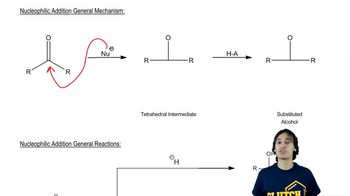
Nucleophilic Addition