
Ch. 14 - NMR Spectroscopy
Bruice - Organic Chemistry 8th Edition
Bruice8th EditionOrganic ChemistryISBN: 9780135213711Not the one you use?Change textbook
Chapter 15, Problem 32a

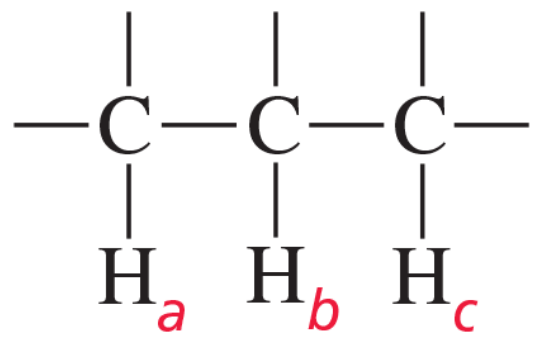
Draw a splitting diagram for Hb, where
a. Jba = 12 Hz and Jbc = 6 Hz.

Verified step by step guidance
1
Step 1: Analyze the molecular structure provided in the image. The molecule consists of three carbons, each bonded to a hydrogen atom (Ha, Hb, Hc) and halogens (Cl and Br). Hb is the central hydrogen, and it is coupled to Ha and Hc through spin-spin interactions.
Step 2: Understand the coupling constants provided. Jba = 12 Hz indicates the coupling between Hb and Ha, while Jbc = 6 Hz indicates the coupling between Hb and Hc. These values represent the strength of the interaction between the nuclei.
Step 3: Determine the splitting pattern for Hb. Since Hb is coupled to two different hydrogens (Ha and Hc) with different coupling constants, the splitting will follow the n+1 rule for each coupling. Ha will split Hb into a doublet (due to Jba = 12 Hz), and Hc will further split each peak of the doublet into a doublet of doublets (due to Jbc = 6 Hz).
Step 4: Draw the splitting diagram. Start with a single peak for Hb. Split this peak into two peaks (doublet) with a separation of 12 Hz due to coupling with Ha. Then, split each of these peaks into two smaller peaks (doublet of doublets) with a separation of 6 Hz due to coupling with Hc.
Step 5: Label the splitting diagram. Clearly indicate the coupling constants (Jba = 12 Hz and Jbc = 6 Hz) on the diagram. Ensure the relative intensities of the peaks are consistent with the expected splitting pattern (1:1:1:1 for a doublet of doublets).

Verified video answer for a similar problem:

This video solution was recommended by our tutors as helpful for the problem above.
Video duration:
6m
Was this helpful?

Key Concepts

Here are the essential concepts you must grasp in order to answer the question correctly.

Spin-Spin Coupling

Spin-spin coupling refers to the interaction between nuclear spins of neighboring atoms, which leads to the splitting of NMR signals. In this context, the coupling constants (J values) indicate the strength of these interactions, affecting the number and pattern of peaks observed in the NMR spectrum.
Recommended video:
Guided course
02:54
Sonogashira Coupling Reaction

Coupling Constants (J values)

Coupling constants, denoted as J, quantify the interaction between spins of adjacent nuclei in NMR spectroscopy. The values, measured in Hertz (Hz), determine the distance between split peaks in the spectrum. For example, Jba = 12 Hz indicates a strong interaction between H_b and H_a, while Jbc = 6 Hz indicates a weaker interaction between H_b and H_c.
Recommended video:
Guided course
12:21
Splitting without J-values

NMR Splitting Patterns

NMR splitting patterns arise from the number of neighboring protons that influence the magnetic environment of a given proton. The n+1 rule states that a proton with n neighboring protons will be split into n+1 peaks. Understanding these patterns is crucial for interpreting the NMR spectrum and deducing the molecular structure.
Recommended video:
Guided course
08:06
Common Splitting Patterns