
Ch. 23 - Benzene I: Aromatic Stability and Substitution Reactions
Mullins - Organic Chemistry: A Learner Centered Approach 1st Edition
Mullins1st EditionOrganic Chemistry: A Learner Centered ApproachISBN: 9780137566471Not the one you use?Change textbook
Chapter 22, Problem 68

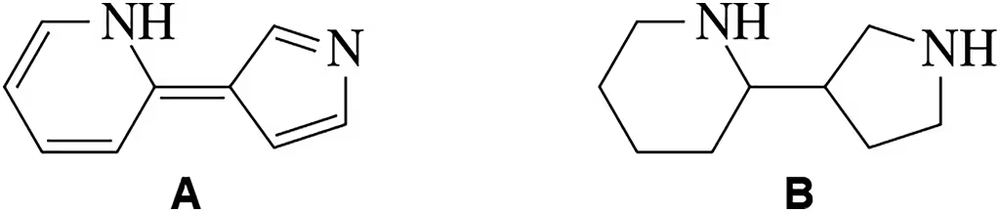
Molecule A is significantly more water soluble than molecule B. Justify this observation.
Chemical structures of two molecules labeled A and B, highlighting differences in their water solubility.

Verified step by step guidance
1
Examine the structures of Molecule A and Molecule B. Molecule A contains two aromatic rings with nitrogen atoms, while Molecule B contains two saturated rings with nitrogen atoms.
Consider the role of aromaticity in solubility. Aromatic rings, like those in Molecule A, can participate in pi-stacking interactions and may also engage in hydrogen bonding with water due to the presence of nitrogen atoms.
Analyze the presence of nitrogen atoms. In Molecule A, the nitrogen atoms are part of aromatic heterocycles, which can enhance solubility through hydrogen bonding with water. In Molecule B, the nitrogen atoms are part of saturated rings, which are less likely to participate in such interactions.
Evaluate the overall polarity of the molecules. Molecule A, with its aromatic rings and nitrogen atoms, is likely more polar than Molecule B, which contributes to its higher water solubility.
Conclude that the increased water solubility of Molecule A is due to its aromatic structure and the presence of nitrogen atoms that can engage in hydrogen bonding, making it more polar and soluble in water compared to Molecule B.

Verified video answer for a similar problem:

This video solution was recommended by our tutors as helpful for the problem above.
Was this helpful?

Key Concepts

Here are the essential concepts you must grasp in order to answer the question correctly.

Polarity

Polarity refers to the distribution of electrical charge over the atoms in a molecule. Molecules with polar bonds have regions of partial positive and negative charges, which allows them to interact favorably with water, a polar solvent. The greater the polarity of a molecule, the more soluble it is in water, as polar molecules tend to dissolve well in polar solvents.
Recommended video:
Guided course
07:13
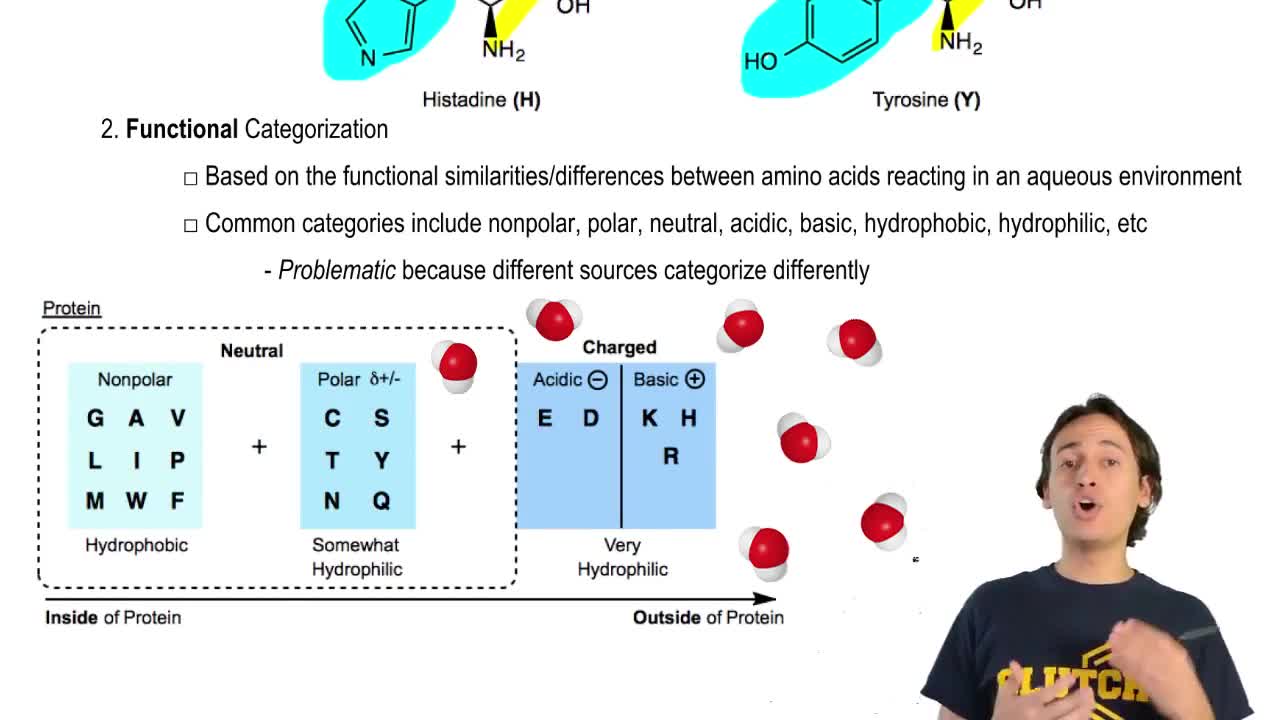
Functional Classification

Hydrogen Bonding

Hydrogen bonding is a type of attractive interaction that occurs between a hydrogen atom bonded to a highly electronegative atom (like oxygen or nitrogen) and another electronegative atom. This interaction significantly increases the solubility of a molecule in water, as it allows for the formation of strong attractions between the solute and solvent molecules, facilitating dissolution.
Recommended video:
Guided course
00:48
The definition of hydrogenation.

Molecular Structure

The molecular structure of a compound, including its functional groups and overall shape, plays a crucial role in its solubility. For instance, the presence of hydroxyl (-OH) groups can enhance water solubility due to their ability to form hydrogen bonds. Conversely, large hydrophobic regions can hinder solubility in water, making it essential to analyze the structural features of molecules A and B to understand their differing solubility.
Recommended video:
Guided course
08:41
Review of Molecular Orbitals