Ch. 23 - Benzene I: Aromatic Stability and Substitution Reactions
Mullins - Organic Chemistry: A Learner Centered Approach 1st Edition
Mullins1st EditionOrganic Chemistry: A Learner Centered ApproachISBN: 9780137566471Not the one you use?Change textbook
Chapter 22, Problem 25c

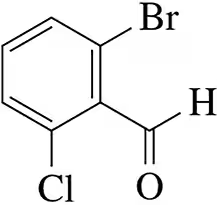
Name the following benzene derivatives according to IUPAC rules.
(c) Chemical structure of a benzene derivative with chlorine, bromine, and hydroxyl groups labeled.

Verified step by step guidance
1
Identify the parent compound: The parent compound in this structure is benzaldehyde, which consists of a benzene ring with an aldehyde group (CHO) attached.
Determine the substituents: The structure has two substituents on the benzene ring: a bromine (Br) and a chlorine (Cl).
Assign locants to the substituents: Number the carbon atoms in the benzene ring starting from the carbon attached to the aldehyde group as position 1. Assign the lowest possible numbers to the substituents. In this case, bromine is at position 3 and chlorine is at position 4.
Name the substituents: The substituents are named as bromo and chloro, based on their respective positions on the benzene ring.
Combine the names: Combine the substituents with the parent compound name, arranging them alphabetically and using the locants. The IUPAC name is 3-bromo-4-chlorobenzaldehyde.

Verified video answer for a similar problem:

This video solution was recommended by our tutors as helpful for the problem above.
Was this helpful?

Key Concepts

Here are the essential concepts you must grasp in order to answer the question correctly.

Benzene Derivatives

Benzene derivatives are compounds that contain a benzene ring substituted with one or more functional groups. The properties and reactivity of these compounds can vary significantly based on the nature and position of the substituents. Understanding how to identify and name these derivatives is crucial for organic chemistry, as it lays the foundation for studying more complex aromatic compounds.
Recommended video:
Guided course
02:49
Aromatic synthesis starting with benzene/benzene derivatives

IUPAC Nomenclature

The International Union of Pure and Applied Chemistry (IUPAC) nomenclature provides a systematic method for naming chemical compounds. For benzene derivatives, the rules include identifying the longest carbon chain, numbering the ring to give substituents the lowest possible numbers, and naming the substituents in alphabetical order. Mastery of IUPAC rules is essential for clear communication in chemistry.
Recommended video:
Guided course
03:43
The different parts of an IUPAC name

Substituent Effects

Substituent effects refer to how different groups attached to a benzene ring influence its chemical behavior and reactivity. Some substituents are electron-donating (activating) while others are electron-withdrawing (deactivating), affecting the ring's susceptibility to electrophilic aromatic substitution reactions. Recognizing these effects is vital for predicting the outcomes of reactions involving benzene derivatives.
Recommended video:
2:02
Directing Effects in Substituted Pyrroles, Furans, and Thiophenes Concept 1