
What is the total number of nodes in the 3 and 4 MOs of 1,3-butadiene?
Verified step by step guidance
1
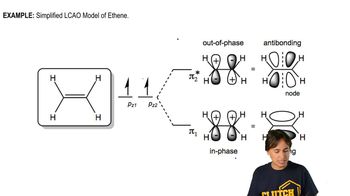
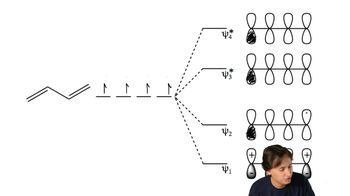
Understand the concept of molecular orbitals (MOs) in conjugated systems: In 1,3-butadiene, the π molecular orbitals are formed by the overlap of four p orbitals from the four sp²-hybridized carbon atoms. These MOs are labeled as ψ₁, ψ₂, ψ₃, and ψ₄, where ψ₁ is the lowest energy orbital and ψ₄ is the highest energy orbital.
Recall the relationship between nodes and molecular orbitals: The number of nodes in a molecular orbital increases with its energy level. Specifically, the number of nodes in a π molecular orbital is equal to (n - 1), where n is the index of the molecular orbital (e.g., ψ₁ has 0 nodes, ψ₂ has 1 node, etc.).
Determine the number of nodes in the c₃ (ψ₃) molecular orbital: Using the formula (n - 1), where n = 3 for ψ₃, calculate the number of nodes in this orbital.
Determine the number of nodes in the c₄ (ψ₄) molecular orbital: Similarly, using the formula (n - 1), where n = 4 for ψ₄, calculate the number of nodes in this orbital.
Add the total number of nodes: Sum the number of nodes in ψ₃ and ψ₄ to find the total number of nodes in the c₃ and c₄ molecular orbitals of 1,3-butadiene.
Verified video answer for a similar problem:
This video solution was recommended by our tutors as helpful for the problem above
Video duration:
3m
Play a video:
0 Comments
Key Concepts
Here are the essential concepts you must grasp in order to answer the question correctly.
Molecular Orbitals (MOs)
Molecular orbitals are formed by the combination of atomic orbitals when atoms bond together. In the case of 1,3-butadiene, the MOs are crucial for understanding the distribution of electrons in the molecule. Each MO can hold a maximum of two electrons and can be classified as bonding, antibonding, or non-bonding based on their energy levels and stability.
Nodes are regions in a molecular orbital where the probability of finding an electron is zero. The number of nodes in an MO is related to its energy level; higher energy MOs have more nodes. For example, the number of nodes can be calculated using the formula: number of nodes = n - 1, where n is the principal quantum number of the MO.
1,3-Butadiene is a conjugated diene with the formula C4H6, consisting of four carbon atoms connected by alternating double bonds. Its structure allows for the formation of π molecular orbitals that are delocalized over the entire molecule. Understanding its structure is essential for determining the characteristics of its molecular orbitals, including the total number of nodes in the c3 and c4 MOs.