Ch. 21 - Amino Acids, Peptides, and Proteins
Bruice - Organic Chemistry 8th Edition
Bruice8th EditionOrganic ChemistryISBN: 9780135213711Not the one you use?Change textbook
Chapter 22, Problem 25

Esterase is an enzyme that catalyzes the hydrolysis of esters. It hydrolyzes esters of l-amino acids more rapidly than esters of D-amino acids. How can this enzyme be used to separate a racemic mixture of amino acids?

Verified step by step guidance
1
Understand the problem: A racemic mixture contains equal amounts of enantiomers (l- and d- forms of amino acids). Esterase is an enzyme that selectively hydrolyzes esters of l-amino acids faster than d-amino acids. This property can be exploited to separate the enantiomers.
Step 1: Convert the racemic mixture of amino acids into their corresponding esters. This can be done by reacting the amino acids with an alcohol in the presence of an acid catalyst to form amino acid esters.
Step 2: Introduce the esterase enzyme to the mixture of amino acid esters. The enzyme will selectively hydrolyze the ester bond of the l-amino acid esters, converting them back into free l-amino acids and leaving the d-amino acid esters largely unreacted.
Step 3: Separate the free l-amino acids from the unreacted d-amino acid esters. This can be achieved using techniques such as chromatography or extraction, as the free amino acids and esters have different chemical properties.
Step 4: If desired, the d-amino acid esters can be hydrolyzed separately (e.g., using acid or base hydrolysis) to obtain the free d-amino acids, completing the separation of the enantiomers.

Verified video answer for a similar problem:

This video solution was recommended by our tutors as helpful for the problem above.
Video duration:
5m
Was this helpful?

Key Concepts

Here are the essential concepts you must grasp in order to answer the question correctly.

Ester Hydrolysis

Ester hydrolysis is a chemical reaction where an ester reacts with water to form an alcohol and a carboxylic acid. This reaction is typically catalyzed by an enzyme or acid/base, and it is crucial in understanding how enzymes like esterase function. In the context of amino acids, esterase selectively hydrolyzes esters formed from l-amino acids more efficiently than those from d-amino acids.
Recommended video:
0:48
Hydrolysis of Phosphate Esters Concept 2

Racemic Mixture

A racemic mixture contains equal amounts of two enantiomers, which are molecules that are mirror images of each other. In the case of amino acids, l- and d-forms are enantiomers. The presence of both forms in a racemic mixture can complicate reactions, but enzymes like esterase can exploit the differences in reactivity to separate these enantiomers based on their stereochemistry.
Recommended video:
Guided course
03:08
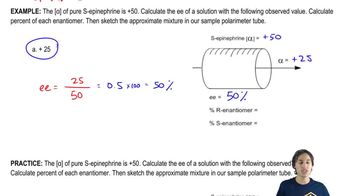
Calculating EE, percent of each enantiomer, and sketching mixture

Enzyme Selectivity

Enzyme selectivity refers to the ability of an enzyme to preferentially catalyze a reaction for one substrate over another. In this case, esterase shows a preference for l-amino acid esters, leading to their faster hydrolysis compared to d-amino acid esters. This selectivity can be harnessed to separate enantiomers in a racemic mixture, as the enzyme will preferentially react with one form, allowing for the isolation of the other.
Recommended video:
Guided course
10:08
Radical selectivity:Alcoholics Anonymous Version