Ch. 17 - Carbonyl Addition Reactions: Aldehydes and Ketones
Mullins - Organic Chemistry: A Learner Centered Approach 1st Edition
Mullins1st EditionOrganic Chemistry: A Learner Centered ApproachISBN: 9780137566471Not the one you use?Change textbook
Chapter 16, Problem 32a

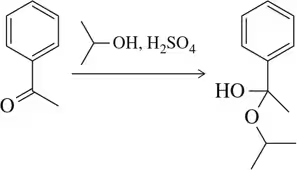
Provide a mechanism for the formation of the hemiacetals shown. [Only (c) is favored as written.]
(a) Chemical reaction mechanism illustrating the formation of a hemiacetal from an aldehyde and an alcohol.

Verified step by step guidance
1
Identify the reactants involved in the formation of a hemiacetal. Typically, a hemiacetal is formed from an aldehyde or ketone reacting with an alcohol.
Recognize the functional groups present in the reactants. The carbonyl group (C=O) in the aldehyde or ketone is the electrophile, while the hydroxyl group (OH) in the alcohol acts as the nucleophile.
Initiate the mechanism by protonating the carbonyl oxygen to make the carbonyl carbon more electrophilic. This is often facilitated by an acid catalyst.
The nucleophilic attack occurs when the alcohol's oxygen atom donates a pair of electrons to the electrophilic carbonyl carbon, forming a new C-O bond.
Complete the mechanism by deprotonating the oxygen atom of the alcohol, resulting in the formation of the hemiacetal. The structure now contains both an alcohol and an ether functional group on the same carbon.

Verified video answer for a similar problem:

This video solution was recommended by our tutors as helpful for the problem above.
Video duration:
2m
Was this helpful?

Key Concepts

Here are the essential concepts you must grasp in order to answer the question correctly.

Hemiacetal Formation

Hemiacetals are formed when an alcohol reacts with an aldehyde or ketone. This reaction involves the nucleophilic attack of the alcohol's hydroxyl group on the carbonyl carbon, leading to the formation of a tetrahedral intermediate. The subsequent proton transfer and loss of water yield the hemiacetal, which contains both an alcohol and an ether functional group.
Recommended video:
Guided course
06:23
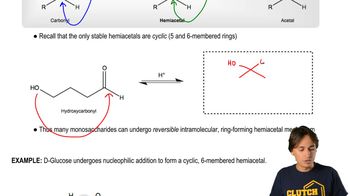
Monosaccharides - Forming Cyclic Hemiacetals

Equilibrium and Favorability

The formation of hemiacetals is an equilibrium process, meaning that both the reactants and products can coexist. The position of this equilibrium can be influenced by factors such as concentration, temperature, and the nature of the reactants. In the context of the question, understanding which hemiacetal is favored requires analyzing these factors and the stability of the resulting structures.
Recommended video:
Guided course
04:00
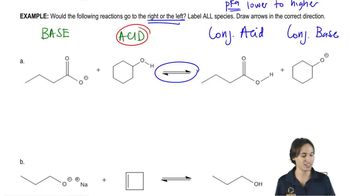
Determining Acid/Base Equilibrium

Mechanistic Steps

The mechanism for hemiacetal formation involves several key steps: nucleophilic attack, formation of a tetrahedral intermediate, proton transfer, and elimination of water. Each step is crucial for understanding how the reaction proceeds and how the structure of the hemiacetal is established. A clear grasp of these mechanistic steps is essential for predicting the outcome of the reaction and the stability of the products.
Recommended video:
1:05
Step-Growth Polymers Concept 1