Ch. 18 - Reactions of Benzene and Substituted Benzenes
Bruice - Organic Chemistry 8th Edition
Bruice8th EditionOrganic ChemistryISBN: 9780135213711Not the one you use?Change textbook
Chapter 19, Problem 70b

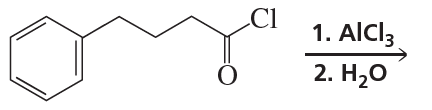
What are the products of the following reactions?
b. Chemical structure showing a benzene ring with a chlorine and carbonyl group, indicating a reaction with aluminum chloride and water.

Verified step by step guidance
1
Step 1: Identify the functional groups in the molecule. The given compound contains a carboxylic acid group (-COOH) attached to a benzyl group (benzene ring with a CH2 group).
Step 2: Recognize the reaction conditions. The presence of H+ (acidic conditions) suggests a decarboxylation reaction, which is common for carboxylic acids with a β-carbonyl group.
Step 3: Analyze the structure for decarboxylation. The carboxylic acid group is adjacent to a carbonyl group, making it suitable for decarboxylation under acidic conditions.
Step 4: Predict the mechanism. In acidic conditions, the carboxylic acid group will lose CO2 (carbon dioxide) via a cyclic transition state, leaving behind a ketone group.
Step 5: Determine the product. After decarboxylation, the benzyl group will remain attached to the ketone, resulting in phenylacetone (C6H5-CH2-CO-CH3).

Verified video answer for a similar problem:

This video solution was recommended by our tutors as helpful for the problem above.
Video duration:
4m
Was this helpful?

Key Concepts

Here are the essential concepts you must grasp in order to answer the question correctly.

Aromatic Compounds

Aromatic compounds are cyclic structures that follow Huckel's rule, containing a planar ring of atoms with delocalized pi electrons. This delocalization imparts unique stability and reactivity characteristics, making them prone to electrophilic substitution reactions. Understanding the structure and stability of aromatic compounds is crucial for predicting their behavior in chemical reactions.
Recommended video:
Guided course
08:19
Intro to Aromaticity

Carbocation Formation

Carbocations are positively charged species that contain a carbon atom with only six electrons in its valence shell, making them electron-deficient and highly reactive. They often form during reactions involving the loss of a leaving group or protonation of an alkene. Recognizing the conditions under which carbocations form is essential for predicting the products of organic reactions.
Recommended video:
Guided course
07:21
Any Carbocation

Electrophilic Substitution Reactions

Electrophilic substitution reactions are a class of reactions where an electrophile replaces a hydrogen atom in an aromatic compound. This process typically involves the generation of a carbocation intermediate, followed by deprotonation to restore aromaticity. Understanding the mechanism of these reactions is vital for predicting the products formed when aromatic compounds react with electrophiles.
Recommended video:
Guided course
01:47
Nucleophiles and Electrophiles can react in Substitution Reactions.