Ch. 6 - The Reactions of Alkenes • The Stereochemistry of Addition Reactions
Bruice - Organic Chemistry 8th Edition
Bruice8th EditionOrganic ChemistryISBN: 9780135213711Not the one you use?Change textbook
Chapter 7, Problem 99

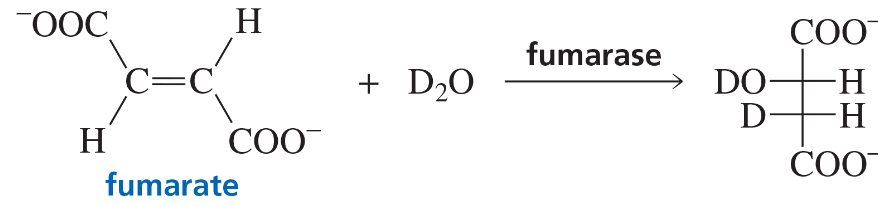
When fumarate reacts with D2O in the presence of the enzyme fumarase, only one isomer of the product is formed, as shown here. Is the enzyme catalyzing a syn or an anti addition of D2O?

Verified step by step guidance
1
Step 1: Analyze the structure of fumarate, which is a trans-alkene with two carboxylate groups (-COO⁻) and two hydrogens attached to the double bond. The trans configuration means the substituents on the double bond are on opposite sides.
Step 2: Observe the product structure. The addition of D2O results in the formation of a single isomer where the deuterium (D) and hydroxyl (OH) groups are added to the carbons of the former double bond. Both D and OH are added to the same face of the molecule.
Step 3: Recall the difference between syn and anti addition. Syn addition occurs when both groups are added to the same face of the double bond, while anti addition occurs when the groups are added to opposite faces.
Step 4: Based on the product structure, where both D and OH are added to the same face, the reaction catalyzed by fumarase is a syn addition of D2O.
Step 5: Conclude that the enzyme fumarase specifically catalyzes a stereospecific syn addition of D2O to fumarate, resulting in the observed single isomer product.

Verified video answer for a similar problem:

This video solution was recommended by our tutors as helpful for the problem above.
Video duration:
1m
Was this helpful?

Key Concepts

Here are the essential concepts you must grasp in order to answer the question correctly.

Fumarate and Fumarase

Fumarate is a dicarboxylic acid and an important intermediate in the citric acid cycle. Fumarase is an enzyme that catalyzes the reversible hydration of fumarate to malate. Understanding the structure of fumarate and the role of fumarase is crucial for analyzing how the enzyme facilitates the addition of water (D2O) to fumarate.
Recommended video:
1:18
The Citric Acid Cycle Example 5

Addition Reactions

Addition reactions involve the addition of atoms or groups to a molecule, typically across a double bond. In the context of fumarate reacting with D2O, it is important to determine whether the addition occurs in a syn (same side) or anti (opposite sides) manner, as this affects the stereochemistry of the product formed.
Recommended video:
1:42
Addition Reactions of Furan Concept 1

Stereochemistry

Stereochemistry is the study of the spatial arrangement of atoms in molecules and how this affects their chemical behavior. In the case of fumarate and D2O, understanding whether the enzyme catalyzes a syn or anti addition is essential for predicting the stereochemical outcome of the reaction and the specific isomer produced.
Recommended video:
1:38
Polymer Stereochemistry Concept 1