Ch. 22 - Catalysis in Organic Reactions and in Enzymatic Reactions
Bruice - Organic Chemistry 8th Edition
Bruice8th EditionOrganic ChemistryISBN: 9780135213711Not the one you use?Change textbook
Chapter 23, Problem 7

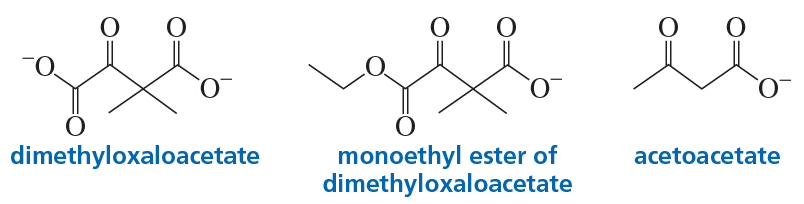
Although metal ions increase the rate of decarboxylation of dimethyloxaloacetate, they have no effect on the rate of decarboxylation of either the monoethyl ester of dimethyloxaloacetate or acetoacetate. Explain why this is so.
Structures of dimethyloxaloacetate, monoethyl ester of dimethyloxaloacetate, and acetoacetate with labels.

Verified step by step guidance
1
Understand the role of metal ions in catalysis: Metal ions can stabilize negative charges that develop during a reaction, particularly on intermediates or transition states. This stabilization lowers the activation energy, increasing the reaction rate.
Analyze the structure of dimethyloxaloacetate: Dimethyloxaloacetate contains two ester groups and a β-keto group. During decarboxylation, the β-keto group forms an enolate intermediate, which has a negative charge on the oxygen atom. Metal ions can stabilize this enolate intermediate, facilitating the reaction.
Compare with the monoethyl ester of dimethyloxaloacetate: The monoethyl ester has one ester group replaced with an ethyl group. This structural change reduces the ability of the molecule to form a stabilized enolate intermediate, as the electron-withdrawing effect of the ester group is diminished. Metal ions cannot significantly stabilize the intermediate in this case, so the rate of decarboxylation is unaffected.
Examine acetoacetate: Acetoacetate is a β-keto acid that undergoes decarboxylation to form an enolate intermediate. However, the enolate intermediate in this case is already stabilized by resonance, and the reaction does not require additional stabilization from metal ions. Thus, metal ions have no effect on the rate of decarboxylation.
Conclude the reasoning: The difference in the effect of metal ions on the decarboxylation rates is due to the structural differences in the molecules and the extent to which the enolate intermediate or transition state can be stabilized by metal ions. Dimethyloxaloacetate benefits from metal ion stabilization, while the monoethyl ester and acetoacetate do not.

Verified video answer for a similar problem:

This video solution was recommended by our tutors as helpful for the problem above.
Video duration:
5m
Was this helpful?

Key Concepts

Here are the essential concepts you must grasp in order to answer the question correctly.

Decarboxylation

Decarboxylation is a chemical reaction that involves the removal of a carboxyl group (-COOH) from a molecule, resulting in the release of carbon dioxide (CO2). This process is crucial in organic chemistry, particularly in metabolic pathways and the synthesis of various compounds. The rate of decarboxylation can be influenced by factors such as the structure of the substrate and the presence of catalysts, including metal ions.
Recommended video:
Guided course
02:32
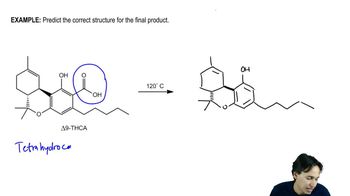
Predict the correct structure

Metal Ion Catalysis

Metal ion catalysis refers to the acceleration of chemical reactions by metal ions, which can stabilize transition states or intermediates. In the context of decarboxylation, metal ions may facilitate the reaction by coordinating with the substrate, thereby lowering the activation energy required for the reaction to proceed. However, the effectiveness of metal ions can vary depending on the specific substrate and its electronic and steric properties.
Recommended video:
3:39
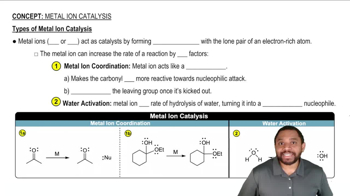
Metal Ion Catalysis Concept 1

Substrate Structure and Reactivity

The structure of a substrate significantly influences its reactivity in chemical reactions. In the case of dimethyloxaloacetate, the presence of specific functional groups and steric factors may make it more susceptible to decarboxylation in the presence of metal ions. Conversely, the monoethyl ester of dimethyloxaloacetate and acetoacetate may have structural features that render them less reactive or less dependent on metal ion catalysis, explaining the observed differences in reaction rates.
Recommended video:
Guided course
01:17
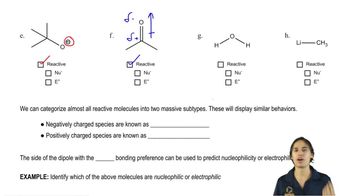
Reactivity of Molecules