Ch. 21 - Amino Acids, Peptides, and Proteins
Bruice - Organic Chemistry 8th Edition
Bruice8th EditionOrganic ChemistryISBN: 9780135213711Not the one you use?Change textbook
Chapter 22, Problem 13

a. What percentage of the a-amino group of lysine will be protonated at its pI?
<25%, 50%, >75%
b. Answer the same question for the e-amino group of lysine

Verified step by step guidance
1
Identify the structure of lysine and its relevant functional groups: lysine has two amino groups (α-amino and ε-amino) and one carboxylic acid group. The α-amino group is attached to the α-carbon, while the ε-amino group is part of the side chain.
Understand the concept of the isoelectric point (pI): The pI is the pH at which the molecule has no net charge. For lysine, this occurs when the carboxylic acid group is deprotonated (-COO⁻), the α-amino group is protonated (-NH₃⁺), and the ε-amino group is also protonated (-NH₃⁺).
Recall the Henderson-Hasselbalch equation: \( \text{pH} = \text{pKa} + \log \left( \frac{[\text{A}^-]}{[\text{HA}]} \right) \). This equation relates the pH, the pKa of a functional group, and the ratio of the deprotonated to protonated forms of that group.
Determine the protonation state of the α-amino group at the pI: At the pI, the pH is approximately the average of the pKa values of the α-amino group and the carboxylic acid group. Use the Henderson-Hasselbalch equation to calculate the ratio of protonated to deprotonated forms of the α-amino group, and then determine the percentage of the α-amino group that is protonated.
Repeat the process for the ε-amino group: At the pI, the ε-amino group is also influenced by its own pKa. Use the Henderson-Hasselbalch equation to calculate the ratio of protonated to deprotonated forms of the ε-amino group, and then determine the percentage of the ε-amino group that is protonated.

Verified video answer for a similar problem:

This video solution was recommended by our tutors as helpful for the problem above.
Video duration:
9m
Was this helpful?

Key Concepts

Here are the essential concepts you must grasp in order to answer the question correctly.

Isoelectric Point (pI)

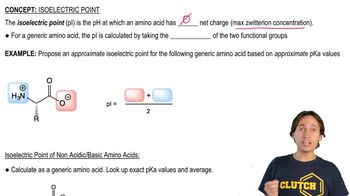
The isoelectric point (pI) is the pH at which a molecule, such as an amino acid, carries no net electrical charge. For amino acids like lysine, the pI is determined by the pKa values of the ionizable groups. At this pH, the positive and negative charges balance out, leading to a neutral overall charge, which is crucial for understanding the protonation state of amino groups.
Recommended video:
Guided course
03:19
Definition of Isoelectric Point

Protonation and Deprotonation

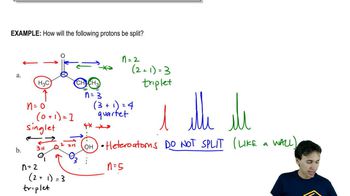
Protonation refers to the addition of a proton (H+) to a molecule, while deprotonation is the removal of a proton. In the context of amino acids, the protonation state of functional groups, such as the amino groups in lysine, depends on the pH of the environment relative to their pKa values. At pH values below their pKa, groups are typically protonated, while at higher pH values, they tend to be deprotonated.
Recommended video:
Guided course
03:
Proton Splitting

Amino Acid Structure and Functional Groups

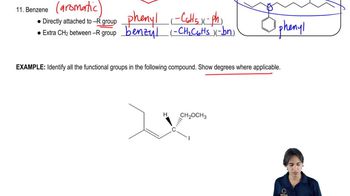
Amino acids consist of a central carbon atom bonded to an amino group, a carboxyl group, a hydrogen atom, and a variable R group (side chain). In lysine, there are two amino groups: the α-amino group and the ε-amino group. Understanding the structure and the specific pKa values of these groups is essential for predicting their protonation states at different pH levels, particularly at the isoelectric point.
Recommended video:
Guided course
02:36
Identifying Functional Groups