Ch. 18 - Reactions of Benzene and Substituted Benzenes
Bruice - Organic Chemistry 8th Edition
Bruice8th EditionOrganic ChemistryISBN: 9780135213711Not the one you use?Change textbook
Chapter 19, Problem 72b

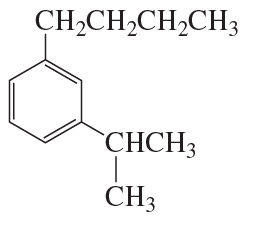
What products are obtained from the reaction of the following compounds with H2CrO4 + ∆?
b. Chemical structure of an aromatic compound with a side chain, showing alkyl groups attached to a benzene ring.

Verified step by step guidance
1
Step 1: Analyze the structure of the given compound. The molecule is a substituted benzene ring with three alkyl groups attached: two tert-butyl groups and one methyl group.
Step 2: Understand the reaction conditions. H2CrO4 (chromic acid) is a strong oxidizing agent, and the presence of heat (∆) indicates that oxidation will occur. Chromic acid typically oxidizes benzylic positions (carbon atoms directly attached to the benzene ring) to carboxylic acids.
Step 3: Identify the benzylic positions in the molecule. The methyl group attached to the benzene ring is a benzylic position, while the tert-butyl groups are not benzylic because they lack hydrogen atoms directly bonded to the carbon attached to the benzene ring.
Step 4: Predict the oxidation outcome. The methyl group at the benzylic position will be oxidized to a carboxylic acid group (-COOH). The tert-butyl groups will remain unchanged because they cannot be oxidized under these conditions.
Step 5: Draw the product structure. The benzene ring will now have a carboxylic acid group (-COOH) in place of the methyl group, while the two tert-butyl groups will remain attached to the ring in their original positions.

Verified video answer for a similar problem:

This video solution was recommended by our tutors as helpful for the problem above.
Video duration:
4m
Was this helpful?

Key Concepts

Here are the essential concepts you must grasp in order to answer the question correctly.

Oxidation Reactions

Oxidation reactions involve the loss of electrons or an increase in oxidation state by a molecule, atom, or ion. In organic chemistry, this often refers to the conversion of alcohols to carbonyl compounds or the oxidation of side chains in aromatic compounds. The use of oxidizing agents like H2CrO4 (chromic acid) facilitates these transformations, leading to the formation of carboxylic acids or ketones.
Recommended video:
Guided course
03:20
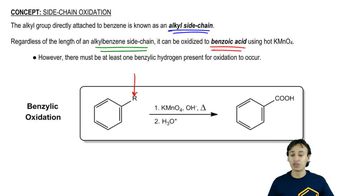
Benzylic Oxidation

Aromatic Compounds

Aromatic compounds are a class of cyclic compounds characterized by their stability and unique electronic structure due to resonance. They typically contain a benzene ring and can undergo various chemical reactions, including electrophilic substitution and oxidation. Understanding the structure and reactivity of aromatic compounds is crucial for predicting the products of reactions involving them, such as the oxidation of side chains.
Recommended video:
Guided course
08:19
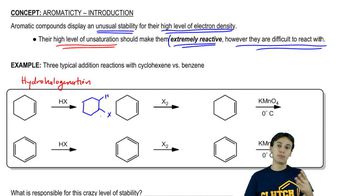
Intro to Aromaticity

Side-Chain Oxidation

Side-chain oxidation refers to the transformation of alkyl groups attached to an aromatic ring into more oxidized functional groups, such as carboxylic acids. When aromatic compounds react with strong oxidizing agents like H2CrO4 under heat, the alkyl side chains can be oxidized, often resulting in the cleavage of the carbon chain and the formation of carboxylic acids. This reaction is significant in organic synthesis and the functionalization of aromatic compounds.
Recommended video:
Guided course
06:14
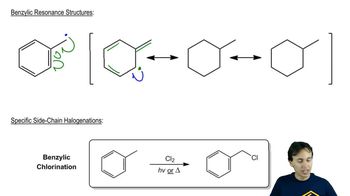
Side-Chain Halogenations