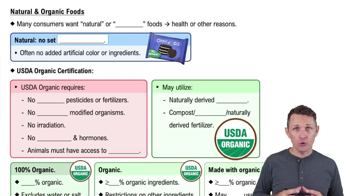
What does the term 'natural' mean when used on food packaging?
The term 'natural' has no regulated definition and usually just implies no artificial additives, but it can mean different things in different contexts.
What are the main requirements for a food to be labeled USDA organic?
USDA organic foods must not use synthetic pesticides or fertilizers, GMOs, irradiation, antibiotics, or hormones, and animals must have access to the outdoors.
Can organic foods contain pesticides?
Yes, organic foods can contain naturally derived pesticides, but not synthetic ones.
What does '100% organic' mean on a food label?
'100% organic' means all ingredients are organic except for water and salt.
What percentage of organic ingredients must a food contain to be labeled simply 'organic'?
It must contain at least 95% organic ingredients, with restrictions on the remaining 5%.
What does 'made with organic ingredients' mean on a food label?
It means the food contains at least 70% organic ingredients, but it cannot use the USDA organic seal.
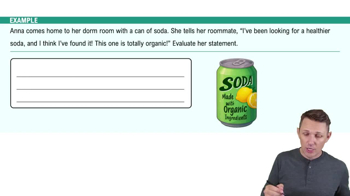
Is there a significant nutritional difference between organic and conventional foods?
No, there is little to no evidence that organic foods are nutritionally better than conventional foods.
How do organic foods differ from conventional foods in terms of pesticide residues?
Organic foods tend to have fewer pesticide residues on average compared to conventional foods.
What are phytochemicals and how do they relate to organic foods?
Phytochemicals are plant compounds that may have health benefits, and organic foods tend to have more of them.
What is a genetically modified organism (GMO)?
A GMO is an organism whose DNA has been altered using recombinant DNA technology to confer specific traits.
Which agencies regulate genetically modified crops in the United States?
The FDA, USDA, and EPA regulate genetically modified crops in the U.S.
What label is required on foods modified using recombinant DNA technology?
Foods must be labeled as 'bioengineered,' though the label may not be prominent and can be a QR code.
What is the most common genetic modification in U.S. corn crops?
The most common modification is the addition of BT proteins for pest resistance, present in over 90% of U.S. corn.
What is the purpose of herbicide resistance in genetically modified crops?
Herbicide resistance allows crops to survive applications of weed killers like glyphosate, making weed control easier for farmers.
What are some concerns associated with genetically modified foods?
Concerns include potential environmental effects, health impacts of specific modifications, and economic issues related to seed costs and large companies.
 Back
Back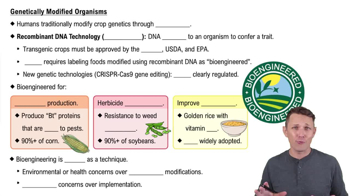
 06:43
06:43