Skip to main content
Nutrition
My Course
Learn
Exam Prep
AI Tutor
Study Guides
Flashcards
Try the app
My Course
Learn
Exam Prep
AI Tutor
Study Guides
Flashcards
Try the app
Back
Micronutrients definitions
You can tap to flip the card.
Micronutrients
You can tap to flip the card.
👆
Micronutrients
Nutrients required in small amounts that support physiological functions but do not provide energy.
Track progress
Control buttons has been changed to "navigation" mode.
1/14
Related flashcards
Related practice
Recommended videos
Micronutrients quiz
Micronutrients
15 Terms
Micronutrients exam
Micronutrients
29 Terms
Micronutrients quiz #1
Micronutrients
10 Terms
Micronutrients
1. Science of Nutrition
10 problems
Topic
Fiber and Phytochemicals
1. Science of Nutrition
10 problems
Topic
1. Science of Nutrition
8 topics
15 problems
Chapter
06:03
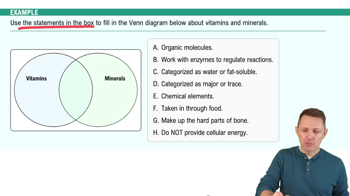
Vitamins & Minerals
1
views
03:04
Micronutrients Example 1
Terms in this set (14)
Hide definitions
Micronutrients
Nutrients required in small amounts that support physiological functions but do not provide energy.
Vitamins
Organic compounds with carbon, essential for various cellular functions, and classified by solubility.
Minerals
Inorganic chemical elements from the periodic table, crucial for body structure and regulation.
Water-Soluble Vitamins
B and C group nutrients not stored in the body; excess amounts are excreted in urine.
Fat-Soluble Vitamins
A, D, E, and K group nutrients stored in body tissues; excessive intake may cause toxicity.
Major Minerals
Inorganic elements needed in amounts greater than 100 mg per day, such as calcium and sodium.
Trace Minerals
Inorganic elements required in amounts less than 100 mg per day, including iron and iodine.
Antioxidants
Molecules that protect cells from damage, commonly found in certain vitamins like C and E.
Enzyme
Protein that accelerates chemical reactions in cells, often requiring vitamins or minerals to function.
Supplementation
Use of products like multivitamins to provide nutrients, sometimes necessary in cases of deficiency.
Varied Diet
Eating a wide range of foods to naturally obtain essential vitamins and minerals.
Hypervitaminosis A
Toxic condition resulting from excessive intake of vitamin A, potentially causing serious health issues.
Cellular Ion Balance
Regulation of charged particles inside and outside cells, maintained by minerals like sodium.
Signaling Molecules
Substances, such as certain vitamins, that direct physiological processes like nutrient absorption.
 BackBack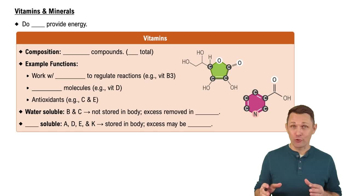
 06:03
06:03