Skip to main content
Nutrition
My Course
Learn
Exam Prep
AI Tutor
Study Guides
Flashcards
Try the app
My Course
Learn
Exam Prep
AI Tutor
Study Guides
Flashcards
Try the app
Back
Intro to Carbohydrates definitions
You can tap to flip the card.
Carbohydrates
You can tap to flip the card.
👆
Carbohydrates
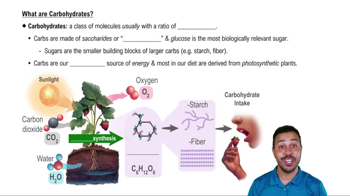
A class of molecules with a carbon to water ratio, serving as a primary energy source and composed of saccharides.
Track progress
Control buttons has been changed to "navigation" mode.
1/15
Related flashcards
Related practice
Recommended videos
Intro to Carbohydrates quiz
Intro to Carbohydrates
15 Terms
Intro to Carbohydrates exam
Intro to Carbohydrates
29 Terms
Intro to Carbohydrates
4. Carbohydrates
10 problems
Topic
Simple vs Complex Carbohydrates
4. Carbohydrates
10 problems
Topic
4. Carbohydrates
9 topics
15 problems
Chapter
Guided course
01:35
Sources of Carbohydrates
Guided course
03:34
What are Carbohydrates?
Guided course
03:40
Intro to Carbohydrates Example 1
Terms in this set (15)
Hide definitions
Carbohydrates
A class of molecules with a carbon to water ratio, serving as a primary energy source and composed of saccharides.
Macronutrient
A nutrient required in large amounts by the body, including carbohydrates, proteins, and lipids.
Saccharides
Sugar units that act as the building blocks for larger carbohydrate molecules like starch and fiber.
Glucose
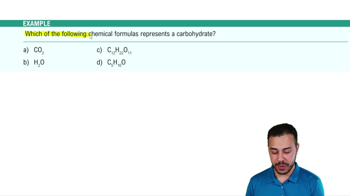
A biologically significant sugar with the formula C6H12O6, serving as a vital energy source.
Starch
A complex carbohydrate found in plants, composed of many glucose units and serving as an energy reserve.
Fiber
A type of carbohydrate from plants that cannot be digested by humans but aids in digestive health.
Photosynthesis
A process in plants that converts carbon dioxide and water into sugars using sunlight energy.
Nutrient Density
A measure of how many nutrients a food provides relative to its calorie content.
Simple Carbohydrates
Carbohydrates consisting of one or two sugar units, often found in fruits and sweetened foods.
Complex Carbohydrates
Carbohydrates made of many sugar units, typically found in grains, vegetables, and legumes.
Sugars
Small carbohydrate molecules, such as glucose, that serve as quick energy sources.
Grains
Plant-based food sources like bread, rice, and pasta, rich in complex carbohydrates.
Dairy Products
Foods derived from milk, such as yogurt and cheese, which can contain carbohydrates.
Energy Source
A role fulfilled by carbohydrates, providing fuel for bodily functions and activities.
Oxygen
A byproduct released during photosynthesis alongside the production of sugars in plants.
 BackBack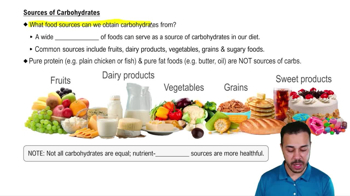
 01:35
01:35