Skip to main content
Nutrition
My Course
Learn
Exam Prep
AI Tutor
Study Guides
Flashcards
Try the app
My Course
Learn
Exam Prep
AI Tutor
Study Guides
Flashcards
Try the app
Back
Food Preservation & Additives quiz
You can tap to flip the card.
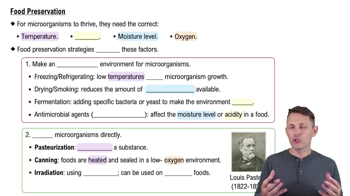
What are the four main environmental factors that food preservation methods alter to inhibit microbial growth?
You can tap to flip the card.
👆
What are the four main environmental factors that food preservation methods alter to inhibit microbial growth?
Temperature, moisture, acidity, and oxygen are the main factors altered to inhibit microbial growth in food preservation.
Track progress
Control buttons has been changed to "navigation" mode.
1/15
Related flashcards
Related practice
Recommended videos
Food Preservation & Additives definitions
Food Preservation & Additives
15 Terms
Food Preservation & Additives
12. Food Safety & Regulation
10 problems
Topic
U.S. Food Safety Systems
12. Food Safety & Regulation
10 problems
Topic
12. Food Safety & Regulation
6 topics
15 problems
Chapter
01:45
Food Preservation & Additives Example 2
04:45
Types of Food Additives
06:06
Food Preservation
Terms in this set (15)
Hide definitions
What are the four main environmental factors that food preservation methods alter to inhibit microbial growth?
Temperature, moisture, acidity, and oxygen are the main factors altered to inhibit microbial growth in food preservation.
How does refrigeration or freezing help preserve food?
Refrigeration slows down microbial growth by lowering temperature, while freezing virtually stops it, extending the food's shelf life.
What is the purpose of drying or smoking food in preservation?
Drying or smoking reduces the moisture content in food, making it harder for microorganisms to survive and grow.
How does fermentation preserve foods like kimchi, sauerkraut, yogurt, and cheese?
Fermentation adds specific bacteria or yeast to increase acidity, creating an environment where most harmful bacteria cannot survive.
What is pasteurization and how does it preserve food?
Pasteurization involves heating food to a temperature that kills bacteria without cooking it, then cooling and sealing it to extend shelf life.
How does canning preserve food and prevent spoilage?
Canning heats food to kill microorganisms and then seals it in a low-oxygen environment, preventing further microbial growth.
What is irradiation in food preservation, and does it make food radioactive?
Irradiation uses radiation like X-rays to kill bacteria on food without making the food radioactive.
What is the role of the FDA in regulating food additives?
The FDA regulates food additives for safety, requiring approval before they can be used in foods.
What does 'Generally Recognized As Safe' (GRAS) mean for food additives?
GRAS means an additive is considered safe based on scientific consensus and long-term use, allowing it to bypass extensive new testing.
At what levels are approved food additives typically used in foods?
Approved additives are used at levels many times lower than the amount shown to cause no harm in studies.
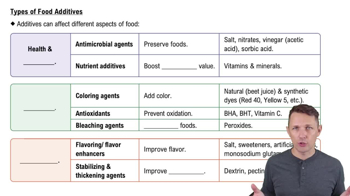
What are common examples of antimicrobial agents (preservatives) used in foods?
Common preservatives include salt, nitrates, vinegar (acetic acid), and sorbic acid.
How do antioxidants like BHA, BHT, and vitamin C help preserve food?
Antioxidants prevent oxidation, which can change the color of food and make it less appealing, even if it's still safe to eat.
What is the function of bleaching agents in food processing?
Bleaching agents, such as peroxide, whiten foods or remove color, commonly used in products like flour and sugar.
What is monosodium glutamate (MSG) and is it safe to consume?
MSG is a flavor enhancer that boosts umami taste and is considered safe, though rare reactions can occur at high doses.
What is the purpose of stabilizing and thickening agents in foods?
Stabilizing and thickening agents like dextrin, pectin, starch, and gums improve the texture of foods by thickening or stabilizing them.
 BackBack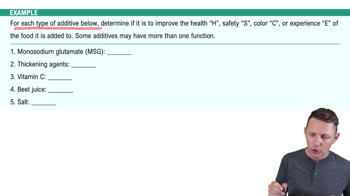
 01:45
01:45