Back

Dietary Guidelines for Americans quiz #1

Control buttons has been changed to "navigation" mode.
1/10
  • What types of foods is the DASH diet abundant in according to the Dietary Guidelines for Americans?

    The DASH diet is abundant in fruits, vegetables, whole grains, lean proteins, and low-fat dairy, emphasizing nutrient-dense foods while limiting added sugars, saturated fats, and sodium.
  • According to the Dietary Guidelines for Americans, should sugar be completely eliminated from a person's diet?

    No, the Dietary Guidelines for Americans recommend limiting added sugars to less than 10% of total calories, not complete elimination.
  • What are discretionary calories as described in the Dietary Guidelines for Americans?

    Discretionary calories refer to the calories remaining after meeting recommended nutrient-dense food group needs within an individual's caloric limit; these can be used for added sugars, fats, or alcohol, but should be limited.
  • What is the main purpose of the MyPlate visual guide according to the Dietary Guidelines for Americans?

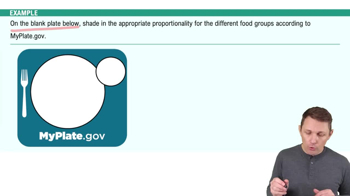
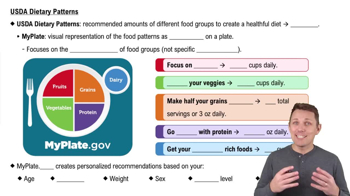
    MyPlate is designed to visually represent the proportionality of food groups on a plate, helping people recognize what a balanced, nutrient-dense diet looks like. It emphasizes the relative amounts of fruits, vegetables, grains, proteins, and dairy to consume throughout the day.
  • How do the Dietary Guidelines for Americans recommend customizing dietary patterns?

    They recommend customizing dietary patterns to reflect personal preferences, cultural traditions, and budgetary considerations. This flexibility allows individuals to fit the guidelines into their unique lifestyles.
  • What is the recommended daily intake of vegetables and fruits according to MyPlate?

    MyPlate recommends two and a half cups of vegetables and one and a half cups of fruits daily. It also suggests that half of your plate should consist of fruits and vegetables.
  • How can you use your hand to estimate common serving sizes when measuring food portions?

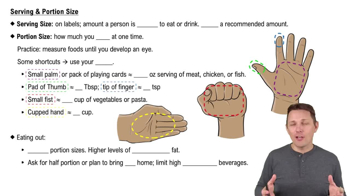
    The palm of your hand is about the size of a three-ounce serving of meat, the pad of your thumb is roughly a tablespoon, and a small fist is about one cup. These hand-based estimates help with portion control when measuring food.
  • What is the difference between serving size and portion size as described in the Dietary Guidelines for Americans?

    Serving size is the amount of food typically listed on food labels and reflects what people usually eat, not a recommended amount. Portion size is the actual amount of food you choose to eat at one time.
  • What are some strategies recommended for managing large portion sizes when eating out?

    Strategies include asking for half portions, planning to eat only half and taking the rest home, and being mindful of high-calorie beverages. These approaches help align restaurant meals with MyPlate recommendations.
  • Why is it important to limit sodium intake to under 2,300 milligrams per day according to the DGAs?

    Limiting sodium to under 2,300 milligrams per day helps reduce the risk of hypertension, or high blood pressure. High sodium intake is associated with negative health outcomes.