Back

Assessing Weight Related Health Risk quiz #1

Control buttons has been changed to "navigation" mode.
1/10
  • What is one major limitation of using Body Mass Index (BMI) to assess health risk?

    BMI does not account for differences in body composition, such as the proportion of muscle versus fat, making it less accurate for individuals with high muscle mass or those over 65 who may have lost muscle and bone.
  • What is the primary purpose of calculating Body Mass Index (BMI)?

    BMI is mainly used as a simple and inexpensive tool to categorize individuals as underweight, healthy weight, overweight, or obese, and to assess health risks related to body weight.
  • BMI is a reliable indicator of total body _____.

    BMI is a reliable indicator of total body weight relative to height, but not of body fat or composition.
  • What is a key limitation of BMI when assessing an individual's health?

    BMI does not distinguish between lean body mass and fat mass, so it may misclassify muscular individuals as overweight or obese and does not account for age-related muscle and bone loss.
  • What does Body Mass Index (BMI) measure?

    BMI measures the ratio of a person's weight to their height squared, providing a general indicator of weight status but not body composition.
  • What does BMI attempt to measure in relation to health?

    BMI attempts to measure whether a person's weight is appropriate for their height, serving as a rough indicator of potential health risks associated with being underweight, overweight, or obese.
  • Why is it important to analyze a person's BMI?

    Analyzing BMI helps quickly assess an individual's risk for chronic diseases associated with weight, such as heart disease and diabetes, by categorizing their weight status.
  • How is Body Mass Index (BMI) calculated?

    BMI is calculated by dividing a person's weight in kilograms by their height in meters squared (BMI = weight (kg) / [height (m)]²).
  • What is central obesity and why is it considered particularly risky for chronic disease?

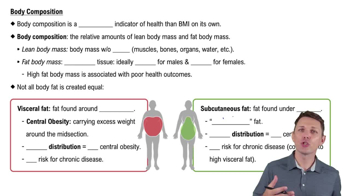
    Central obesity refers to carrying excess weight around the midsection, which is associated with higher levels of visceral fat. This type of fat increases the risk for chronic diseases more than subcutaneous fat does.
  • How does bioelectrical impedance estimate body fat percentage, and what factors can affect its accuracy?

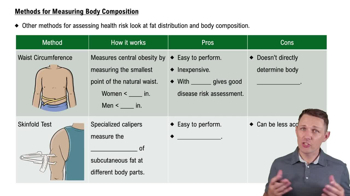
    Bioelectrical impedance estimates body fat by measuring how well an electrical current passes through the body, with lean tissue conducting better than fat. Its accuracy can be affected by hydration status, recent food or exercise, and alcohol consumption.