Skip to main content
Microeconomics
My Course
Learn
Exam Prep
AI Tutor
Study Guides
Flashcards
Explore
Try the app
My Course
Learn
Exam Prep
AI Tutor
Study Guides
Flashcards
Explore
Try the app
Back
The Production Function and Diminishing Returns definitions
You can tap to flip the card.
Production Function
You can tap to flip the card.
👆
Production Function
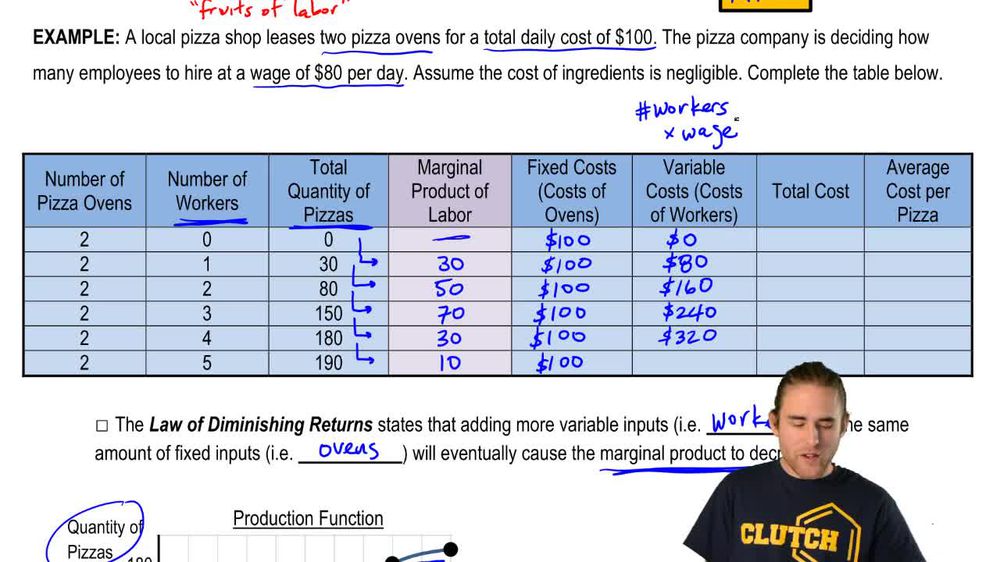
Shows how output changes as more inputs are added, mapping workers to pizzas produced in a business.
Track progress
Control buttons has been changed to "navigation" mode.
1/15
Related flashcards
Related practice
Recommended videos
The Production Function and Diminishing Returns quiz #1
The Production Function and Diminishing Returns
13 Terms
The Production Function and Diminishing Returns
10. The Costs of Production
10 problems
Topic
Marginal Cost
10. The Costs of Production
10 problems
Topic
10. The Costs of Production
9 topics
15 problems
Chapter
Guided course
07:45
The Production Function and Diminishing Returns
6
views
Guided course
05:09
Calculating Fixed Cost, Variable Cost, and Average Total Cost
5
views
Terms in this set (15)
Hide definitions
Production Function
Shows how output changes as more inputs are added, mapping workers to pizzas produced in a business.
Marginal Product of Labor
Measures the increase in output from hiring one additional worker, revealing productivity changes.
Fixed Cost
Expense that remains unchanged regardless of output, such as daily oven rental in a pizza shop.
Variable Cost
Expense that rises with increased production, like wages paid for each additional worker hired.
Total Cost
Sum of fixed and variable expenses, representing the overall spending to produce a given output.
Average Cost
Calculated by dividing total expenses by the number of units produced, indicating cost per item.
Law of Diminishing Returns
Describes how adding more workers to fixed resources eventually leads to reduced productivity per worker.
Specialization
Division of tasks among workers, increasing efficiency and output when labor is optimally allocated.
Optimal Point
Moment when adding workers maximizes productivity before diminishing returns begin to reduce gains.
Average Total Cost
Represents the per-unit expense when both fixed and variable costs are considered for all output.
Input
Resource used in production, such as labor or equipment, necessary for creating goods or services.
Output
Quantity of goods produced, like pizzas, resulting from combining various resources in production.
Productivity
Efficiency of converting inputs into outputs, often reflected in the marginal product of labor.
Wage
Payment made to workers for their labor, forming the basis of variable costs in production.
Resource Constraint
Limitation imposed by fixed assets, such as ovens, restricting how much additional labor can boost output.
 BackBack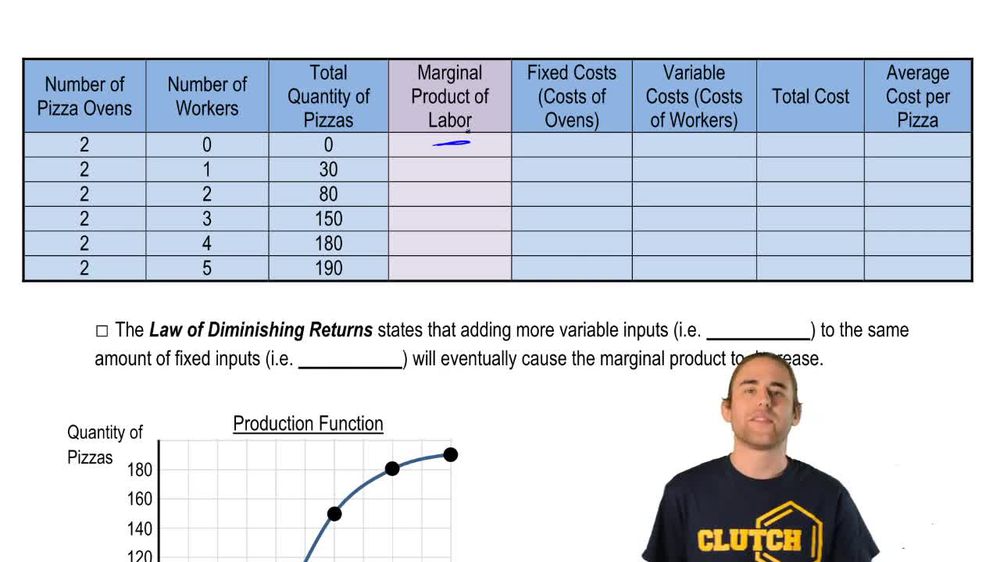
 07:45
07:45