Why is the money supply curve vertical on the money market graph?
Because the Federal Reserve sets a fixed quantity of money in circulation, making the supply independent of the interest rate.
What does the y-axis represent on the money supply and demand graph?
The y-axis represents the interest rate, which is considered the price of money.
What does the x-axis represent on the money supply and demand graph?
The x-axis represents the quantity of money, or the number of dollars available in the economy.
Who controls the supply of money in the U.S. economy?
The Federal Reserve (the Fed) controls the supply of money.
What is M1 in the context of the money supply?
M1 includes currency in circulation and checking account deposits.
What are open market operations?
Open market operations are the buying and selling of Treasury securities (T-bills) by the Fed to influence the money supply.
What happens to the money supply when the Fed purchases T-bills?
The money supply increases because money moves from the Fed to the public (mainly banks).
What happens to the money supply when the Fed sells T-bills?
The money supply decreases because money moves from the public to the Fed.
How does an increase in the money supply affect the equilibrium interest rate?
An increase in the money supply shifts the supply curve right, lowering the equilibrium interest rate.
How does a decrease in the money supply affect the equilibrium interest rate?
A decrease in the money supply shifts the supply curve left, raising the equilibrium interest rate.
What is the equilibrium in the money market?
It is the point where the money supply and money demand curves intersect, determining the equilibrium interest rate and quantity of money.
Why might the Fed want to lower the interest rate through open market operations?
To encourage investment by making loans cheaper, especially during economic downturns like recessions.
What is the liquidity preference theory?
It is the theory that applies supply and demand principles to the money market, with money demand sloping downward and money supply being fixed by the Fed.
What does it mean when money is 'in the money supply'?
It means the money is in the hands of the public (including banks), available for use, not held by the Fed.
How do open market operations shift the money supply curve?
Purchasing T-bills shifts the curve right (increases supply), while selling T-bills shifts it left (decreases supply).
 Back
Back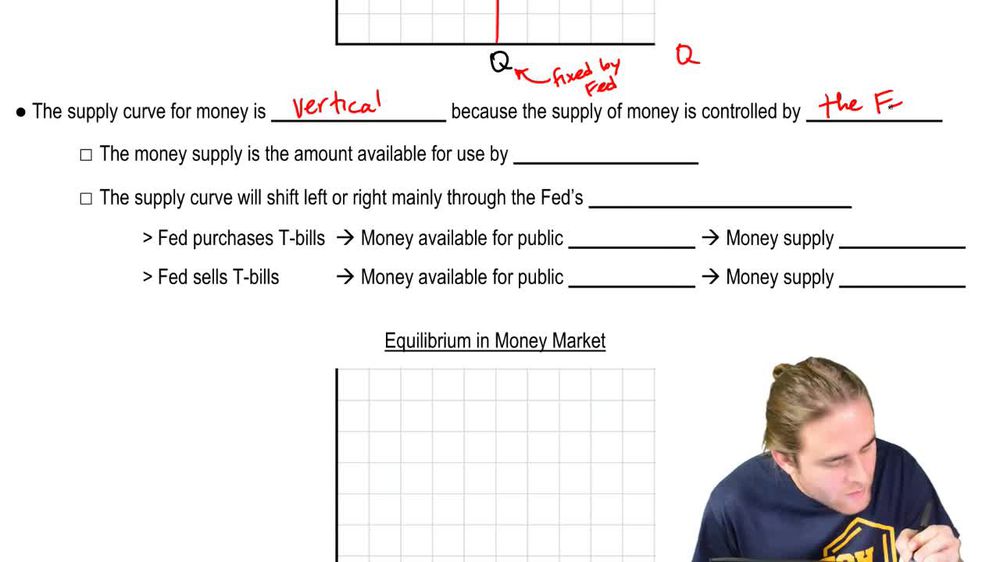
 11:53
11:53