Skip to main content
Microeconomics
My Course
Learn
Exam Prep
AI Tutor
Study Guides
Flashcards
Explore
Try the app
My Course
Learn
Exam Prep
AI Tutor
Study Guides
Flashcards
Explore
Try the app
Back
The Functions of Money; The Kinds of Money definitions
You can tap to flip the card.
Medium of Exchange
You can tap to flip the card.
👆
Medium of Exchange
Enables trading goods and services without requiring direct barter, acting as an intermediary in transactions.
Track progress
Control buttons has been changed to "navigation" mode.
1/15
Related flashcards
Recommended videos
The Functions of Money; The Kinds of Money quiz
The Functions of Money; The Kinds of Money
15 Terms
Guided course
01:33
Kinds of Money
1
views
Guided course
02:30
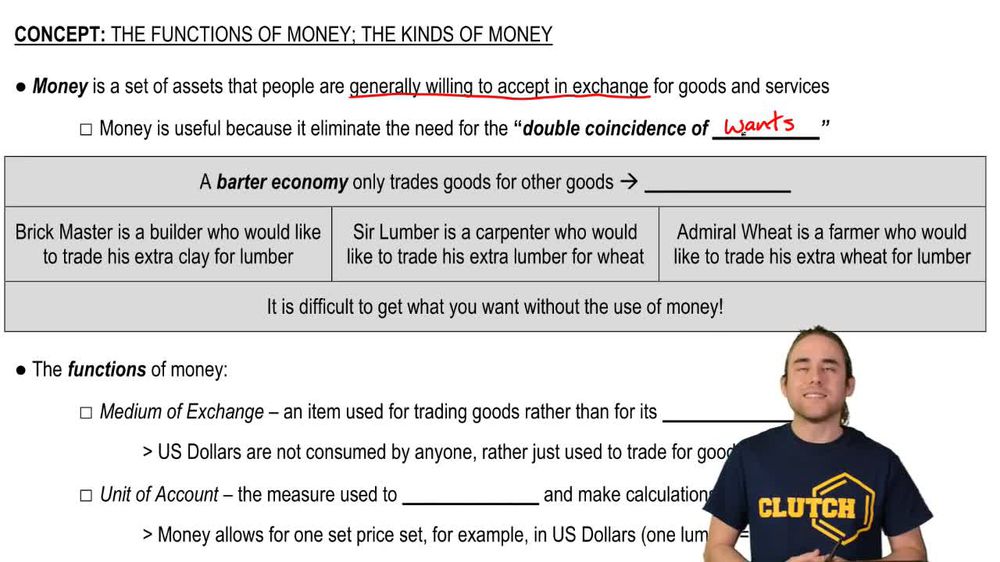
Definition of Money; Barter Economy; Double Coincidence of Wants
1
views
Guided course
04:06
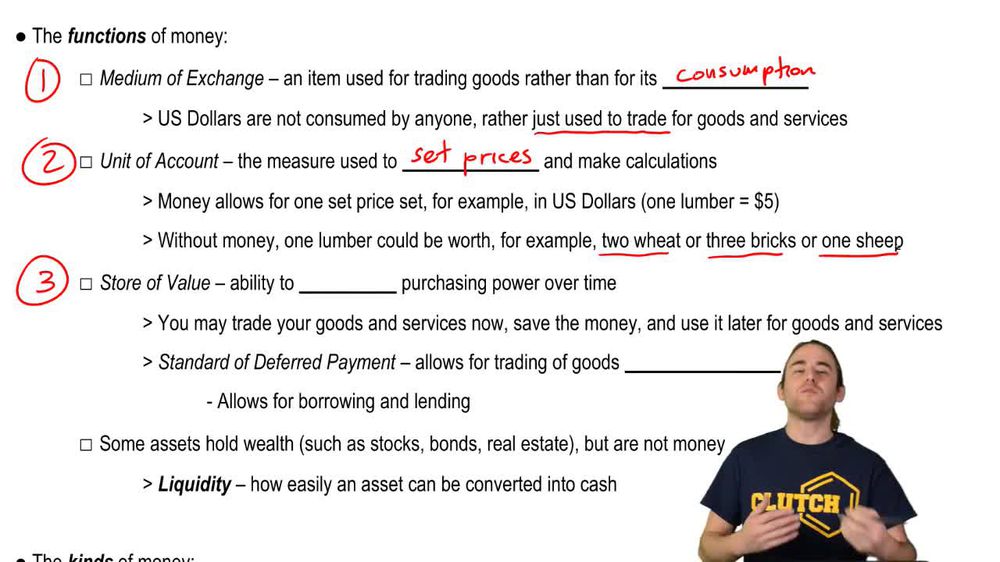
Functions of Money
1
views
Terms in this set (15)
Hide definitions
Medium of Exchange
Enables trading goods and services without requiring direct barter, acting as an intermediary in transactions.
Unit of Account
Provides a standard measure for pricing goods and services, simplifying value comparisons and calculations.
Store of Value
Allows purchasing power to be retained over time, enabling saving and future spending.
Double Coincidence of Wants
Occurs when two parties each possess something the other desires, necessary for barter transactions.
Barter Economy
System where goods and services are exchanged directly without a monetary intermediary.
Fiat Money
Currency with value established by government decree, lacking intrinsic worth or alternative uses.
Commodity Money
Currency with inherent value and alternative uses, such as gold, beyond its role in exchange.
Liquidity
Describes how quickly and easily an asset can be converted into cash without significant loss of value.
Deferred Payment
Facilitates transactions where payment is made in the future, relying on money’s ability to retain value.
Purchasing Power
Represents the amount of goods and services that can be acquired with a unit of currency.
Asset
Anything of value owned that can be exchanged or converted into cash, including money, stocks, or real estate.
Market Equilibrium
State where supply and demand are balanced, often facilitated by standardized pricing through money.
Transaction Cost
Expenses incurred during the process of buying or selling, reduced by the use of money.
Opportunity Cost
Value of the next best alternative forgone when a choice is made, clarified by monetary transactions.
Economic Profit
Difference between total revenue and total costs, including opportunity costs, often measured in monetary terms.
 BackBack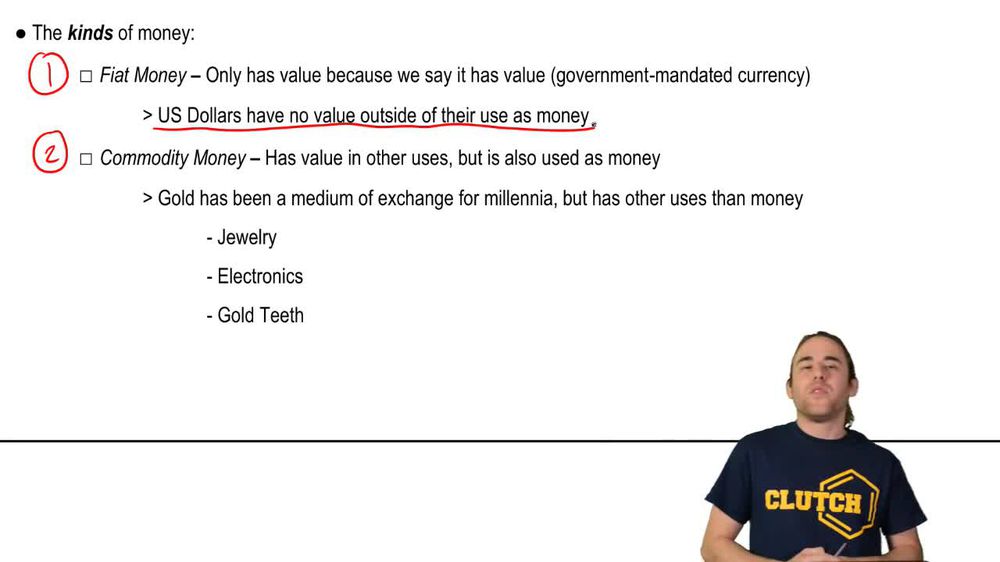
 01:33
01:33